Freelancer vs. Agency vs. In-House: How to Actually Decide

Hire a freelancer for one narrow, well-defined task. Choose an agency when you need design, development and launch moving together on a deadline, and build an in-house team once you have product-market fit and steady work for the year ahead.
We are an agency, so take our view with the grain of salt it deserves. The honest answer is that agencies are not always the right call, and this guide shows where each option wins and where it quietly costs you more.
Key takeaways
- A freelancer is the cheapest and fastest option for one task with a clear spec, and the riskiest for anything that needs coordination.
- An agency sells coordination as much as execution: design, development and launch become one team's responsibility instead of yours.
- An in-house team pays off after product-market fit, when the work is steady and you can manage people well.
- Every option has hidden costs: your management time, handoffs, recruiting and idle capacity.
- Whoever you choose, keep the code, accounts and documentation in your name from day one.
What does each option actually give you?
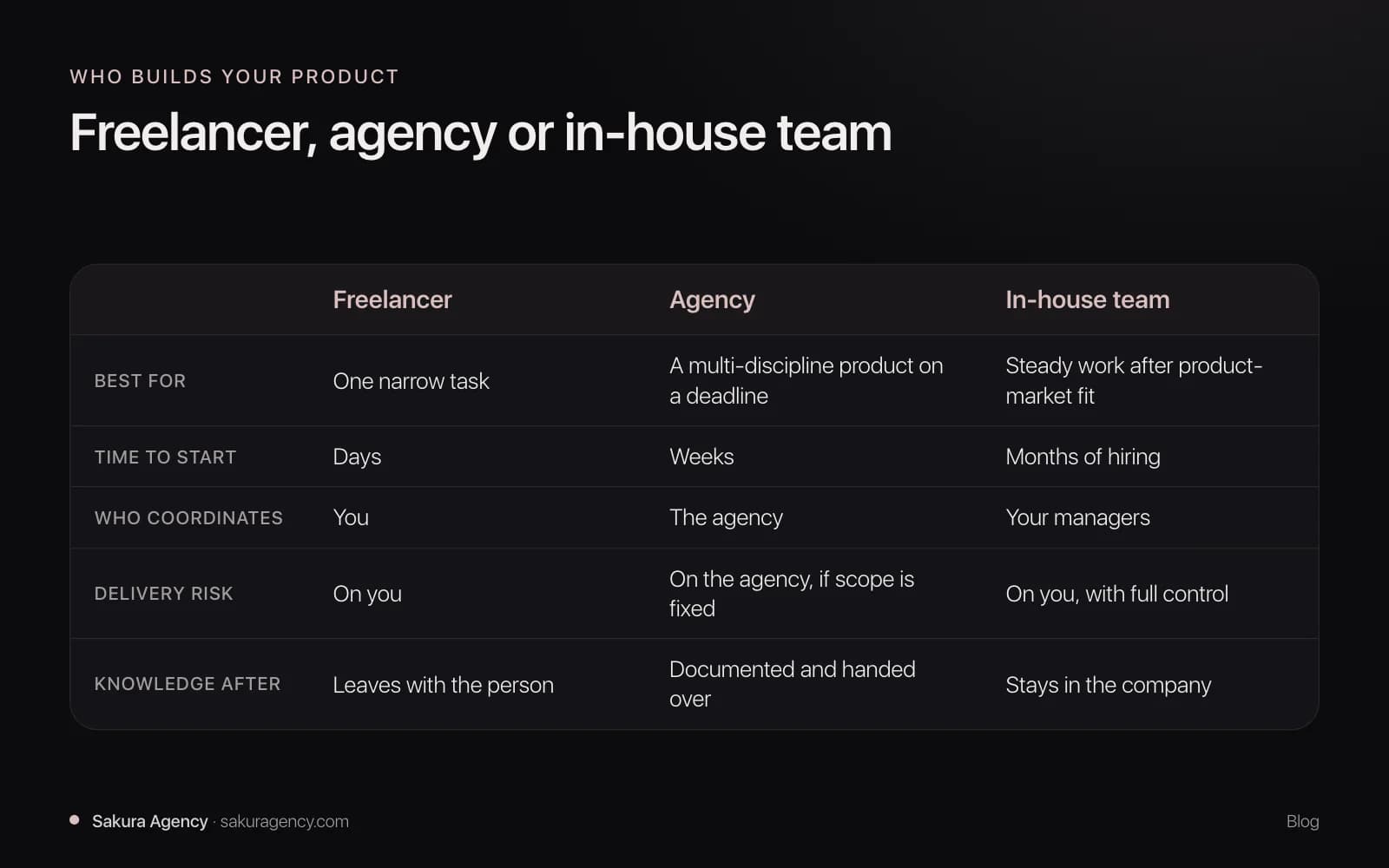
The three options differ less in skill than in who carries the coordination and the delivery risk. This table is the short version of the rest of the article.
| Freelancer | Agency | In-house team | |
|---|---|---|---|
| Best for | One narrow task with a clear spec | A product that needs several disciplines on a deadline | Ongoing work after product-market fit |
| Time to start | Days | Weeks, after a brief and a proposal | Months of hiring |
| Who coordinates | You | The agency | Your managers |
| Delivery risk | On you, and on one person's availability | On the agency, if scope and price are fixed | On you, with full control |
| Cost structure | Hourly or per task | Fixed price by milestone, or a retainer | Salaries, benefits, tools, recruiting |
| Knowledge after the project | Leaves with the person | Documented and handed over, if agreed | Stays in the company |
When is a freelancer the right choice?
A freelancer works best when the task is narrow enough for one person to own from start to finish. A landing page, a specific integration, a design refresh or a performance fix are good examples.
The advantages are real. You can start within days, you pay only for the work, and a strong specialist can be better at one thing than a generalist team.
The risks grow with every discipline you add:
- You become the project manager. Briefing, reviewing, chasing deadlines and joining work from several people is now your job.
- One person is a single point of failure. Illness, a better-paid project or a holiday stops your product.
- Handoffs fall through the gaps. A designer's file and a developer's build rarely match without someone owning the space between them.
For example, a startup that needs a marketing site redesigned before a funding round can hire one strong freelancer and be done in a few weeks. A startup that needs a new product with web, mobile and payments should not try to assemble five freelancers itself.
When does an agency make sense?
You pay an agency for coordination as much as for execution. Design, development, testing and launch become one team's responsibility, and scope, timeline and quality have one owner.
That matters most when several disciplines must move in parallel. CarPixly, an AI photo studio for car listings, needed product design, a web app, a marketing site and three languages from day one. Splitting that across independent freelancers would have turned the founder into a full-time coordinator.
An agency has honest downsides too. You pay for its overhead, its people know your market less well than you do, and a weak agency can hide a junior team behind a senior pitch. Our guide on how to choose a development agency covers the questions that expose this before you sign.
At Sakura, a co-founder or the tech lead runs every project and answers to you for the result. For the build we bring in vetted specialists from our network, matched to your stack.
When should you build an in-house team?
Build your own team when the work is steady and you know what it is. That usually means after product-market fit, when the roadmap for the next year is clear and someone can manage engineers well.
Before that point, an in-house team is often the most expensive way to learn. Hiring takes months, and the role you hire for may change before the person starts.
Fixed costs also shorten your runway. In CB Insights' 2026 review of 431 VC-backed companies that shut down since 2023, 70% ran out of capital. A payroll you cannot pause is a bet that the product is already right.
Not sure which side of that line you are on? Tell us what you are building and we will say honestly whether an agency, a freelancer or a first hire fits better.
What are the hidden costs of each option?
The rate or salary is the visible part of the price. The hidden part decides whether the choice was actually cheap.
| Option | Hidden costs to plan for |
|---|---|
| Freelancer | Your management time, rework between specialists, delays when the person is unavailable |
| Agency | Overhead in the rate, change requests outside the agreed scope, a handover if you later move in-house |
| In-house | Recruiting time and fees, onboarding, management, tools, idle capacity between projects |
A useful habit: estimate your own hours per week for each option and price them. Founders often find that the "cheap" option costs them a day a week of coordination.
If you want a feel for typical build budgets first, our breakdown of what a SaaS MVP costs gives real ranges by complexity.
What should you ask a freelancer before you hire?
A short conversation tells you most of what you need to know. These questions work for any discipline:
- Can you show me two or three projects like mine that are live today?
- How many other clients will you work with at the same time?
- What happens if you get sick or need to stop halfway?
- Will the code, designs and accounts be in my name from the first day?
- How will you show progress, and how often?
Listen for concrete answers and for honesty about limits. A freelancer who says "this part is outside what I do well" is more valuable than one who says yes to everything.
Agree on the scope and the price of the first piece of work in writing, even if it is small. A short paid test task is often the best interview there is.
Can you combine freelancers, an agency and your own team?
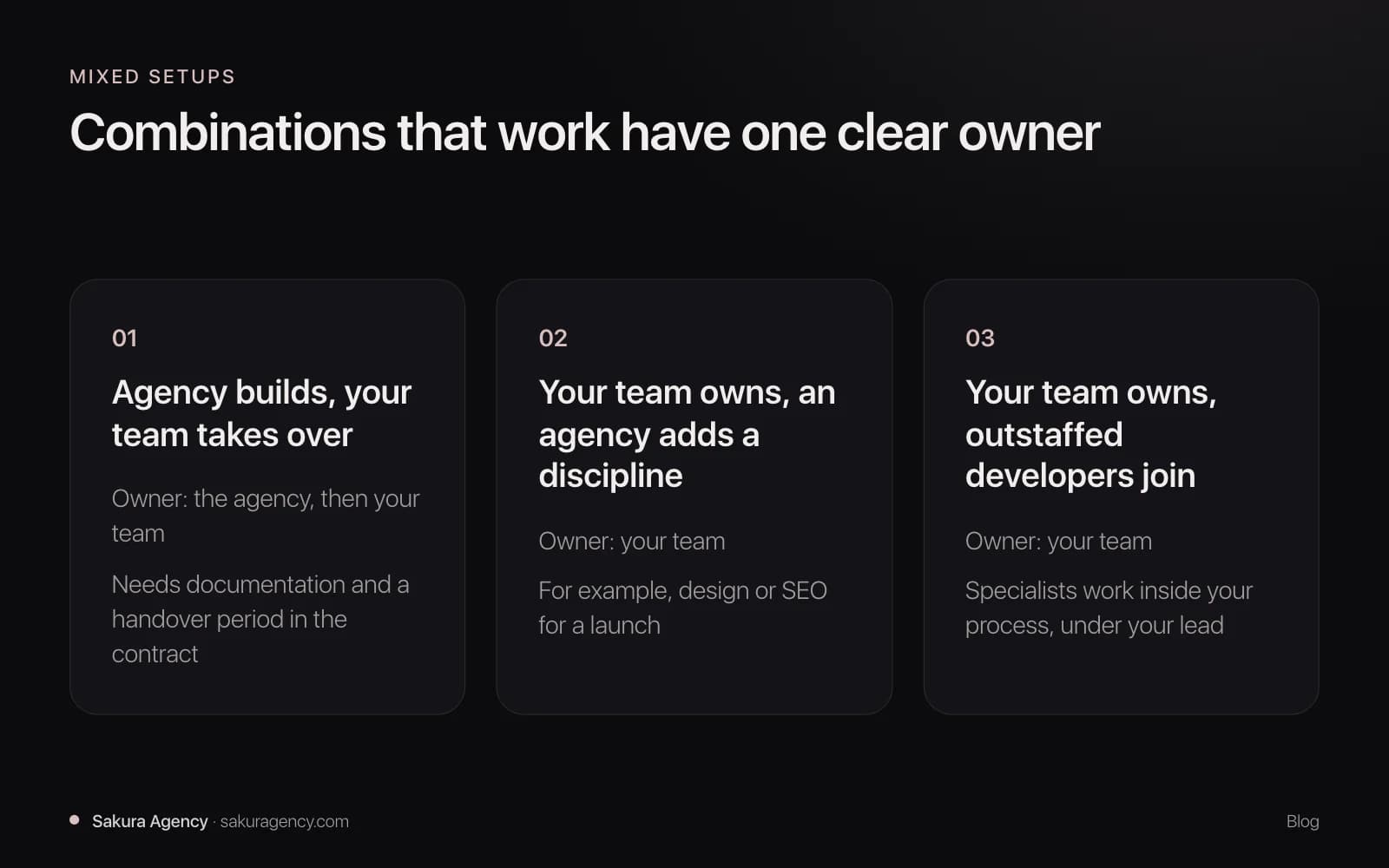
Yes, and most growing startups do. The combinations that work have one thing in common: one person or team clearly owns the product as a whole.
- An agency builds the first version, then hands over to your hires. This works when documentation and a handover period are part of the contract from the start.
- Your team owns the product, and an agency adds a discipline. For example, design or SEO for a launch your engineers have no time for.
- Your team owns the product, and outside developers join it. With developer outstaffing, a specialist works inside your process and under your lead.
AutoIntel, a B2B tool for the German used-car market, started with product design and an interactive prototype. The client used the prototype to align its own team and scope the build, so the next step could go to whichever team fit best.
A quick decision framework
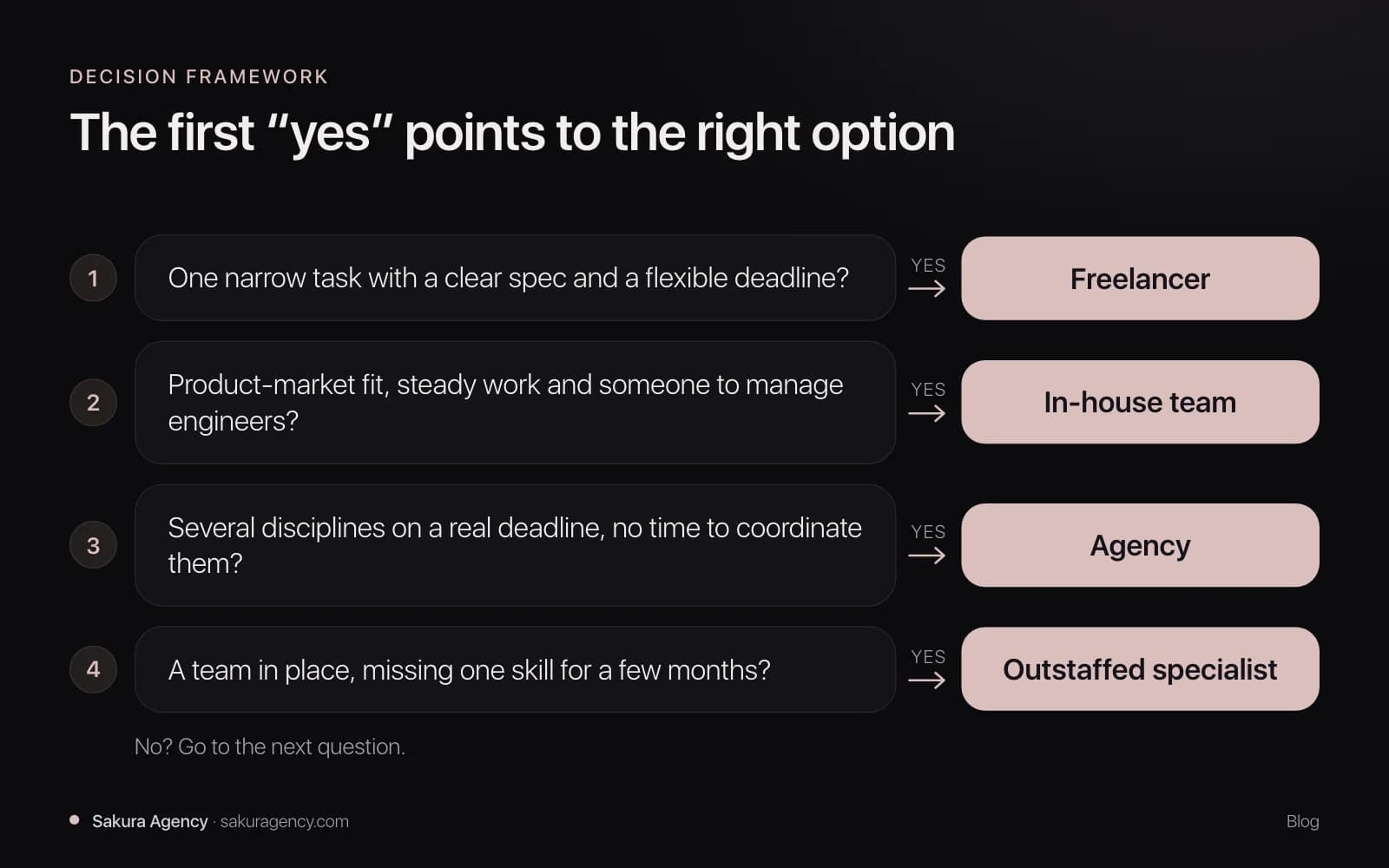
Answer these questions in order. The first "yes" usually points to the right option.
- Is it one narrow task with a clear spec and a flexible deadline? Hire a freelancer.
- Do you have product-market fit, steady work and someone to manage engineers? Build an in-house team.
- Do you need several disciplines moving together on a real deadline, without the time to coordinate them yourself? Hire an agency.
- Do you have a team but lack one skill for a few months? Add an outstaffed specialist.
How do you protect yourself whichever you choose?
The same safeguards work for a freelancer, an agency and your own hires. Put them in place before the first line of code:
- Own the accounts. The repository, hosting, domain, app store and analytics accounts should be registered to your company. Moving a repository later is possible, as GitHub's documentation shows, but it is easier never to need it.
- Write the scope down. List what is included, what is excluded and how changes are approved.
- Pay by milestone. Tie payments to things you can check, such as approved designs or a working build on a test link.
- Ask for documentation as a deliverable. Whoever comes next should not have to reverse-engineer the product.
- Check security basics. Ask how the team handles the risks in the OWASP Top 10, the standard list of the most critical web application risks.
How do you make the final call?
Pick the option whose weak spot you can live with. A freelancer's weak spot is coordination, an agency's is cost and distance from your market, and an in-house team's is time and fixed cost.
If you are pre-product-market fit and need a whole product, an agency or a small mixed setup is usually the safer bet. Once the product works and the roadmap is steady, start hiring and plan the handover.
If you want a second opinion on your situation, send us a short brief. We will tell you if we are not the best choice.
FAQ
- Is a freelancer always cheaper than an agency?
The hourly rate usually is, but the total cost often is not. Once you add your own coordination time and the rework between several specialists, a fixed-price agency project can cost the same or less.
- When should a startup hire its first in-house developer?
Usually after product-market fit, when there is steady work for at least the next year. Before that, flexible options cost less and let you change direction without layoffs.
- Can an agency hand a product over to my in-house team?
Yes, if the handover is planned from the start. Ask for documentation, a handover period and all accounts in your name as written deliverables.
- What is the difference between an agency and outstaffing?
An agency owns delivery of a defined scope. With outstaffing, a specialist joins your team and works under your management, while the provider handles hiring and replacement.
- How do I avoid getting stuck with a freelancer who disappears?
Keep the code in your own repository and every account in your company's name. Pay by milestone and ask for short documentation as part of each delivery.
About the author
Vladimir Kurilo
Co-founder of Sakura Agency. Leads product and business.