How Much Does It Cost to Build a SaaS MVP?

A SaaS MVP usually costs between $15,000 and $70,000 and takes 6 to 14 weeks to build. Complex products with custom logic, several integrations and admin tooling start around $70,000 and can pass $150,000.
These are the ranges we see when we scope real projects at Sakura. Where your product lands depends less on the idea itself and more on a handful of decisions you control.
This guide walks through each of those decisions, with the numbers behind them and the trade-offs we would point out if you were sitting across the table from us.
Key takeaways
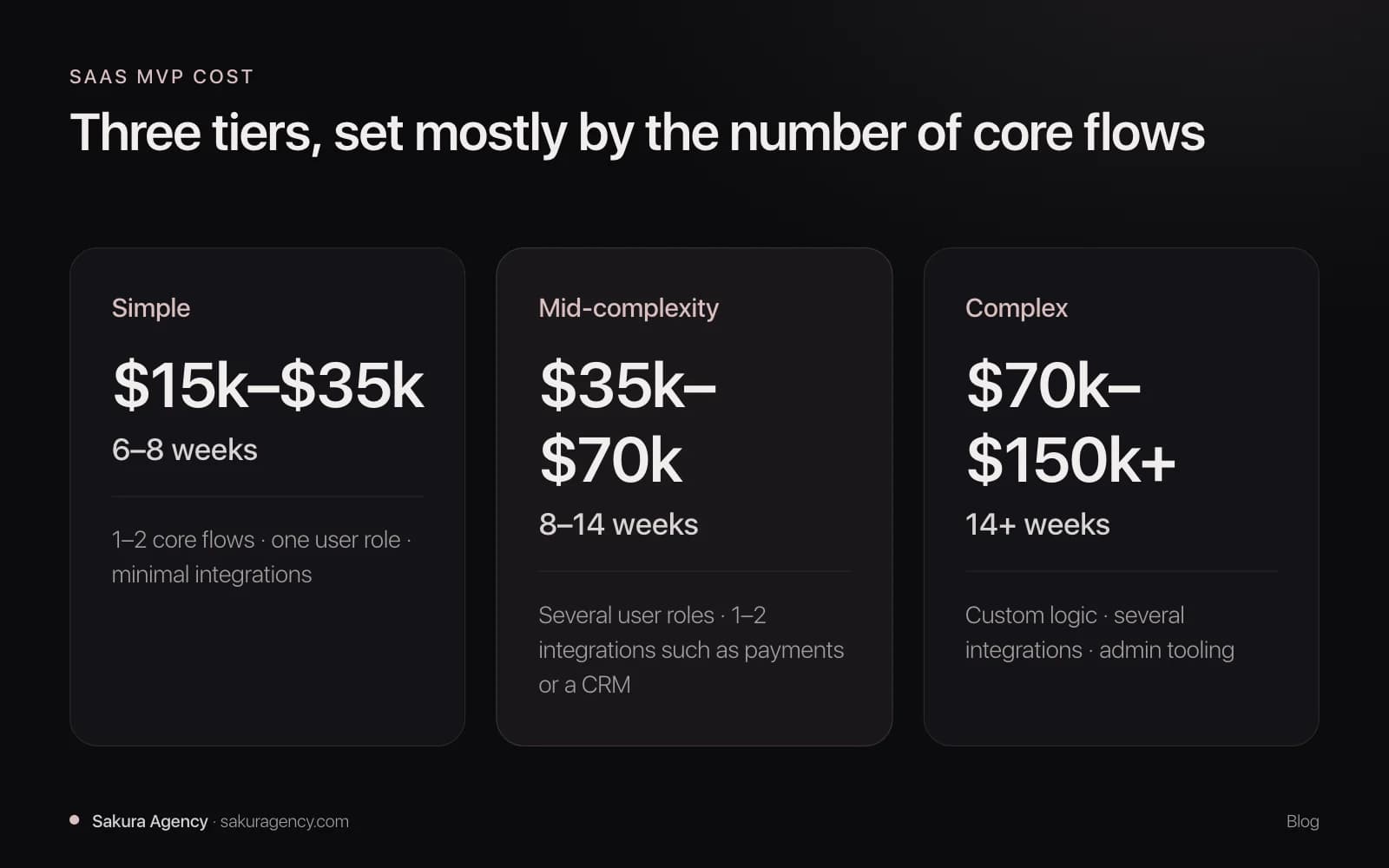
- Simple SaaS MVPs cost $15,000–$35,000 (6–8 weeks), mid-complexity ones $35,000–$70,000 (8–14 weeks), and complex ones $70,000–$150,000+ (14+ weeks).
- The biggest cost driver is the number of core user flows, not the number of features or screens.
- Payments, sign-in and other integrations each add scope, so use proven services instead of building your own.
- Budget for running costs after launch: hosting, subscriptions, payment fees and support.
- A fixed-scope quote with milestone payments protects your budget better than an open hourly estimate.
How much does a SaaS MVP cost by complexity?
Most SaaS MVPs fall into one of three tiers. The tier depends on how many distinct jobs the product does for its users and how much custom logic sits behind them.
| Tier | What it usually includes | Typical cost | Typical timeline |
|---|---|---|---|
| Simple | 1–2 core flows, one user role, minimal integrations | $15,000–$35,000 | 6–8 weeks |
| Mid-complexity | Several user roles, 1–2 integrations such as payments or a CRM | $35,000–$70,000 | 8–14 weeks |
| Complex | Custom business logic, several integrations, admin tooling | $70,000–$150,000+ | 14+ weeks |
These are ranges, not quotes. Two products in the same tier can still differ by tens of thousands of dollars, because the details inside each flow matter.
The ranges cover design, development, testing and launch. They do not cover what it costs to run the product afterwards, which we cover further down.
What is a core flow, and why does it drive the price?
A core flow is one complete job a user comes to do, from the first click to the result. "Sign up and invite a teammate" is a flow. "Upload a document and get a report" is another.
Every flow needs screens, states, backend logic, stored data and tests. Ten screens that serve one flow cost less than ten screens spread across five flows, because each flow brings its own edge cases.
Edge cases are where the money goes. What happens when the upload fails, the payment is declined, or the user closes the tab halfway through? Each answer is design work, code and a test.
For example, a startup that explains lab results in plain language can launch with one flow: upload a file, read the explanation. One flow done well carries the whole product, and that focus keeps it in the lower tiers.
Which features push the budget up fastest?
Some features look small in a brief and turn out to be large in the build. These are the ones we flag most often:
- Integrations. Payments, sign-in with Google, CRMs, email providers and third-party APIs each add setup, error handling and testing.
- Roles and permissions. A product with admins, managers and customers needs every screen to behave correctly for each role.
- Data-heavy interfaces. Dashboards, tables, filters and exports take more design and engineering time than content pages with the same screen count.
- Real-time features. Chat, live updates and shared editing need extra infrastructure and careful testing.
- A native mobile app next to the web app. It adds a second front end and an app store review step.
- A compressed deadline. Going faster means more people working in parallel, and coordination costs money too.
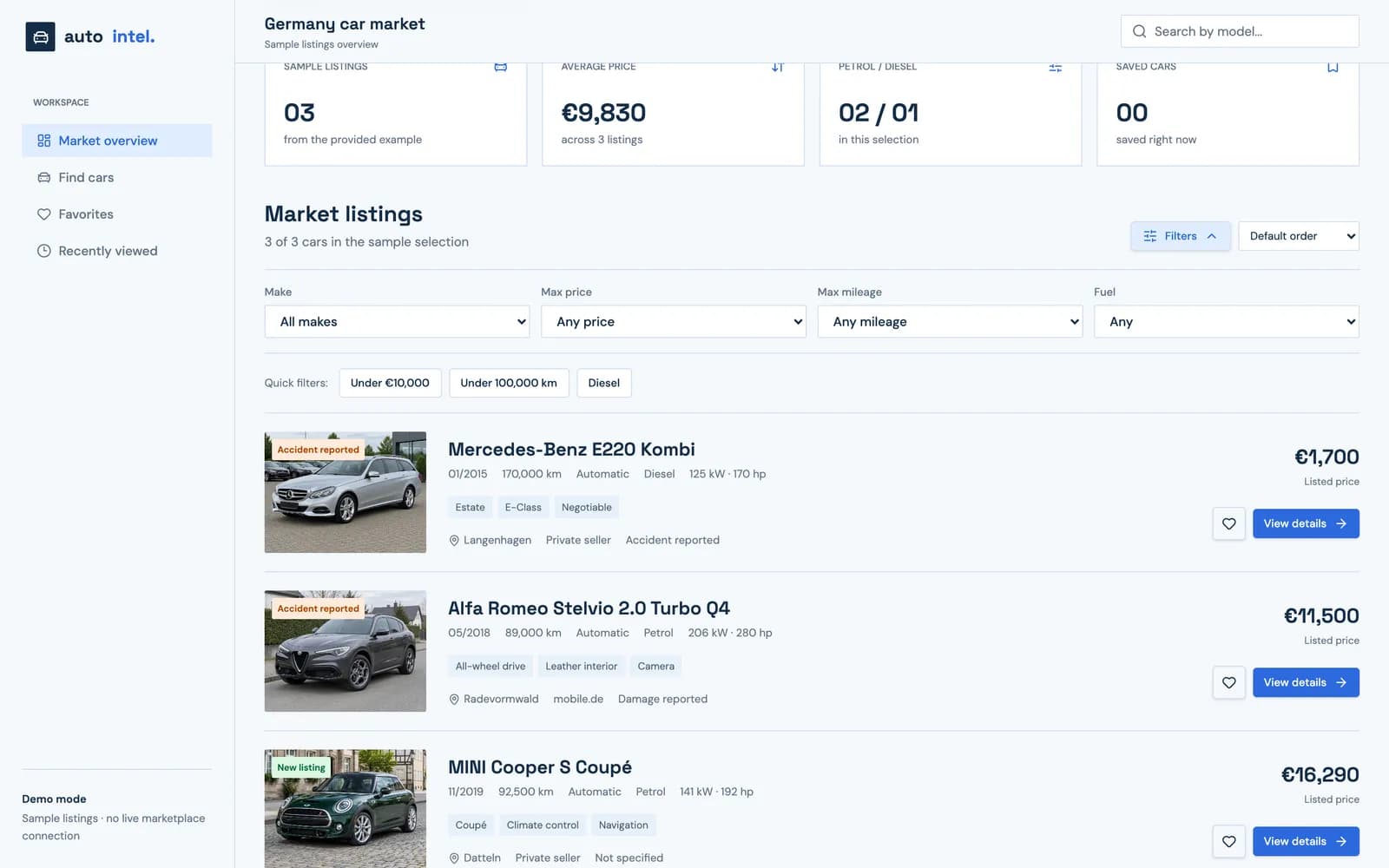
For example, AutoIntel is a data-heavy B2B tool that gathers used-car listings from several German marketplaces. We designed the workspace first and built an interactive prototype on sample listings. The client could settle which fields and filters matter before paying for the data pipeline behind them.
How do payments and other integrations affect the cost?
Integrations are where estimates most often go wrong. The happy path is quick to build. Declined cards, expired sessions, webhooks that arrive twice and refunds are not.
The cheapest way to add payments is a hosted checkout from a provider such as Stripe, rather than a custom payment form. You also pay the provider per transaction: Stripe's standard rate for domestic cards in the US is 2.9% + 30¢. That is a running cost, not a build cost, but it belongs in your plan.
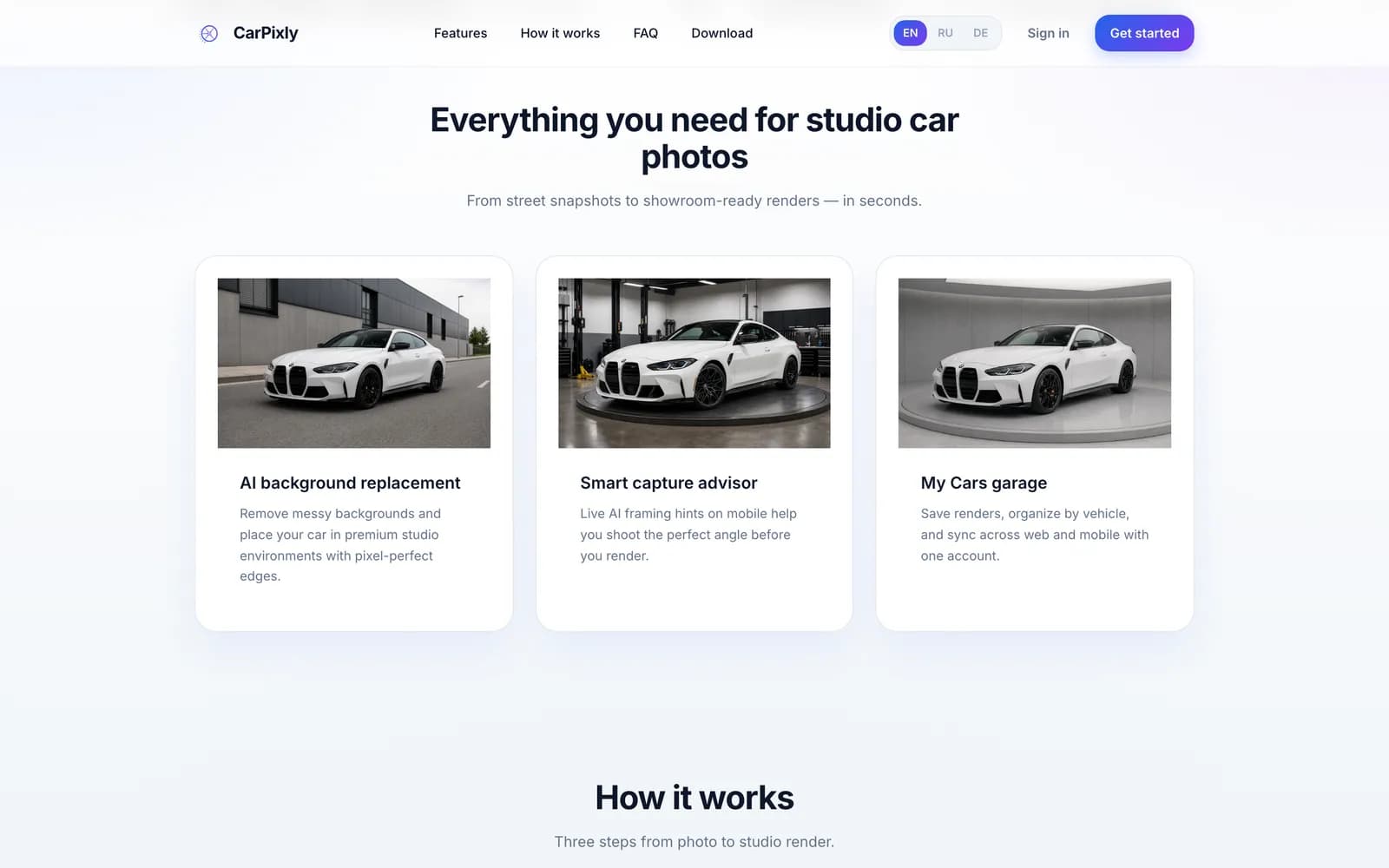
CarPixly, an AI photo studio for car listings, sells renders for credits topped up through a hosted checkout. An admin panel lets the team change the price of custom backgrounds without a new release. That kind of decision keeps billing out of the developers' queue after launch.
What does an MVP cost after launch?
The build price is only part of the bill. Plan for these running costs from the first month:
- Hosting, database and file storage.
- Third-party subscriptions: email delivery, authentication, analytics, maps or AI APIs.
- Payment processing fees on every transaction.
- App store fees, if you sell inside a mobile app.
- Bug fixes and small improvements as real users arrive.
Ask any agency to estimate the monthly running cost in its proposal. At Sakura, every project includes a defined support window for bug fixes. Ongoing work after that runs on a monthly support plan you can stop at any time.
Not sure which tier your idea falls into? Send us a short brief and we will tell you where it lands. Most of our proposals go out within 2–3 business days of a completed brief.
How can you lower the cost without cutting quality?
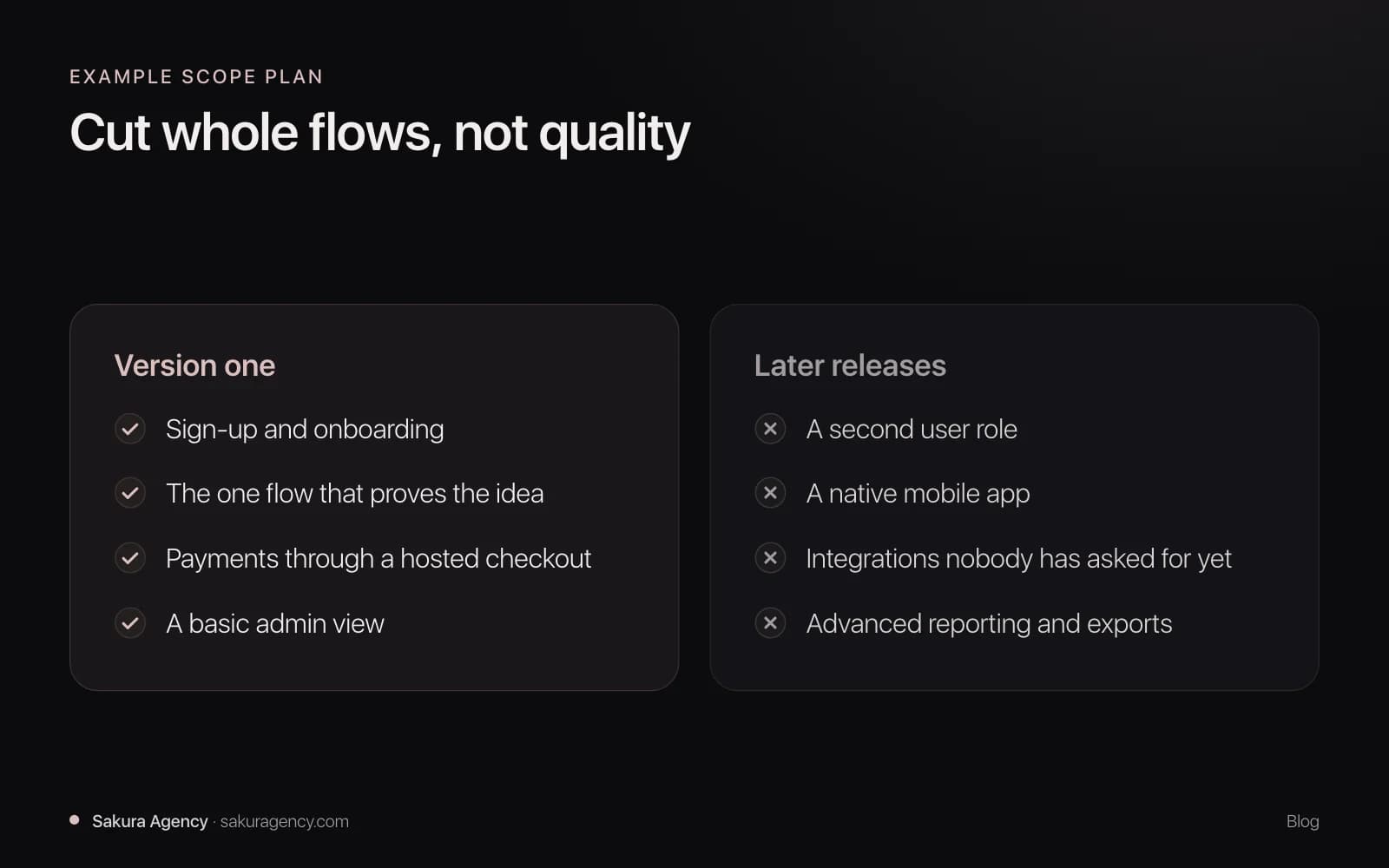
Cut scope, not quality. A product with three flows built properly beats one with eight flows built thin, because users judge it by the flows they actually use.
- Choose the one or two flows that prove your idea. Everything else goes on a "later" list with a reason next to it.
- Decide the core before scoping, not during development. Changing direction mid-build is the most expensive way to learn.
- Use existing infrastructure. Auth providers, payment processors and email services are cheaper and safer than custom versions.
- Design in real components. When design and code share one component system, nothing gets rebuilt between the design file and the browser.
- Launch on one platform first. A responsive web app reaches phone and desktop users and skips app store review while you are still learning.
Does the technology stack change the price?
Less than most founders expect. The stack matters most for what happens after launch: how easy it is to hire developers, how fast the product loads and how much it costs to run.
A good agency picks the stack for your product, your budget and your future hires, not the one it happens to know best. For many web products that means a popular, well-supported framework such as Next.js; for mobile, often React Native, which serves iOS and Android from one codebase.
Be careful with two extremes:
- An exotic stack can be fast to start but hard to staff later, which raises every future change.
- A no-code tool for a complex product can be cheap for the first version and expensive to replace once you outgrow it.
Speed is part of the stack decision too. At Sakura we target 95+ on Google PageSpeed Insights before launch, because a slow product costs you users from the first day.
Why do MVP budgets run over?
Running out of money is how most startups end. In CB Insights' 2026 analysis of 431 VC-backed companies that shut down since 2023, 70% ran out of capital and 43% had poor product-market fit.
An MVP is supposed to buy you learning before the money runs out. Budget overruns eat into exactly that runway. The usual causes are predictable:
- New features added mid-project without a written change process.
- Hourly billing on work nobody defined up front.
- Rework when designs turn out to be expensive to build.
- Integrations estimated as a single line instead of their real edge cases.
Each of these is a process problem, not bad luck. A proposal with a clear scope, a written list of exclusions and a change process removes most of them.
Should you pay a fixed price or by the hour for an MVP?
For an MVP with defined core flows, a fixed scope and price protects your budget. The agency carries the risk of its own estimate, and you know the cost before work starts.
Hourly billing makes sense when the work genuinely cannot be defined yet, such as early research or a technical unknown. We compare both models in detail in fixed price vs. hourly development.
Whichever model you choose, tie payments to milestones you can check: approved designs, a working build on a test link, a launch. At Sakura we never take 100% before work begins.
How do you get an exact number for your project?
An exact quote needs an understanding of what you are building, not a feature list. A short brief with these five points is enough to start:
- Who the users are and what problem they have today.
- The one to three jobs the product must do at launch.
- Any integrations you already know you need.
- Your deadline, and what drives it.
- A rough budget range, so the scope can be shaped to fit it.
The goal of an MVP, in the Lean Startup's words, is "to begin the process of learning as quickly as possible". A good quote is shaped around that goal. If timing matters as much as money, read our guide on how long it takes to build an MVP.
When you are ready, tell us about your product. We will reply with questions first and a fixed proposal after.
FAQ
- Can I build a SaaS MVP for under $15,000?
Sometimes, if the product is one narrow flow built on existing services. Below that budget, a clickable prototype to test demand is often a better use of the money than a thin product.
- How long does it take to build a SaaS MVP?
Usually 6–8 weeks for a simple product, 8–14 weeks for mid-complexity and 14 weeks or more for a complex one. A native mobile app adds app store review time on top.
- Is it cheaper to hire freelancers for an MVP?
The hourly rate is often lower, but you take on the coordination between design, development and testing. For one narrow task a freelancer can be the cheaper choice. For a whole product, count your own management time as part of the price.
- What should be included in the MVP price?
Design, development, testing, deployment and a support window for bug fixes after launch. Ask for a written list of exclusions, such as copywriting, third-party subscriptions or app store fees.
- Do I need a mobile app for my first version?
Usually not. A responsive web app reaches desktop and phone users, costs less to change and skips app store review while you are still learning what users need.
About the author
Vladimir Kurilo
Co-founder of Sakura Agency. Leads product and business.