How Long Does It Take to Build an MVP? Real Timelines by Product Type

Co-Founder, Product & Business
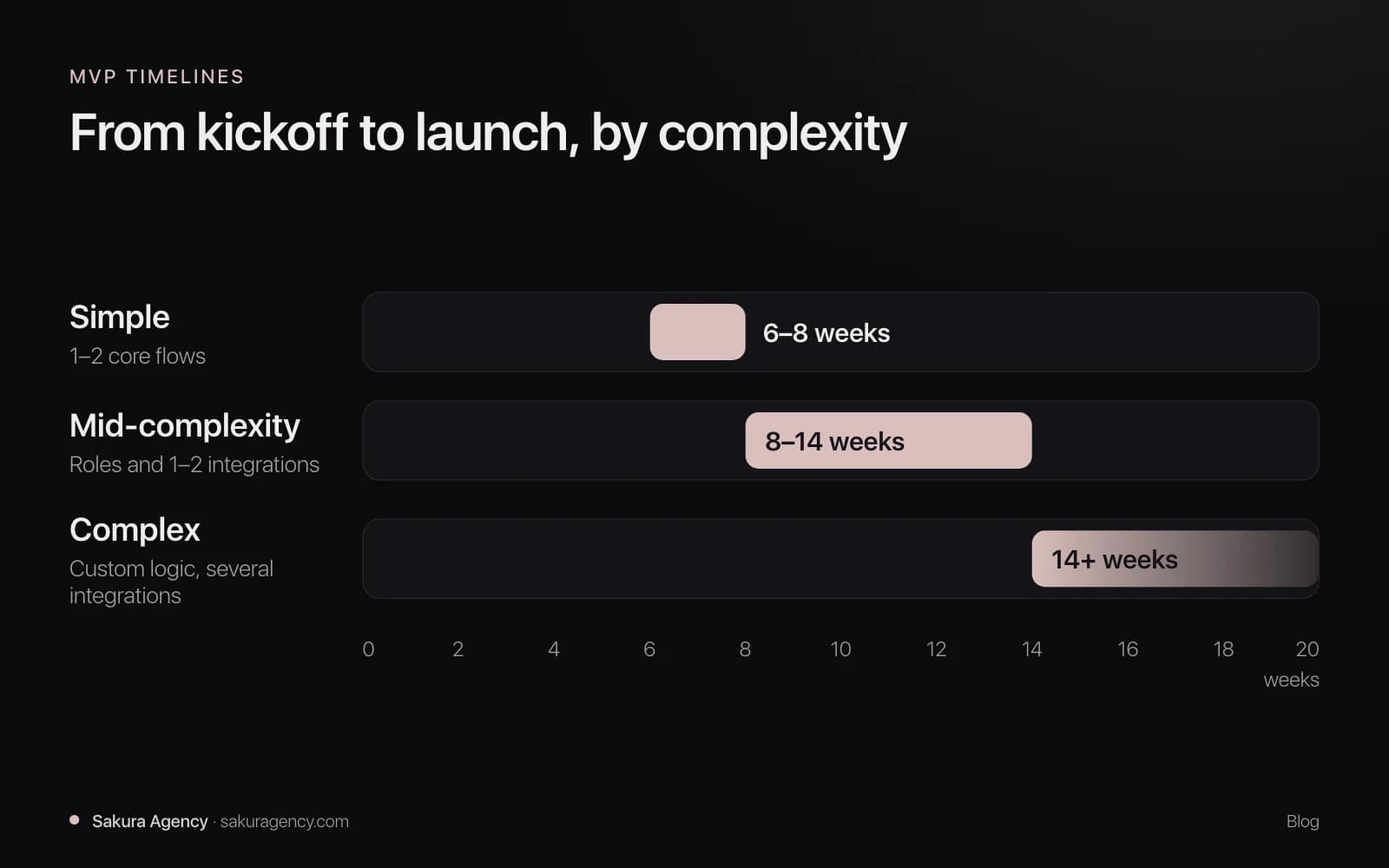
Most MVPs take 6 to 14 weeks from kickoff to launch: 6–8 weeks for a simple product with one or two core flows, and 8–14 weeks for a mid-complexity one. Products with custom logic, several integrations and admin tooling take 14 weeks or more.
A native mobile app adds app store review on top. Apple says it reviews 90% of submissions in less than 48 hours, but a rejection sends you back to the queue.
These are the ranges we see when we plan real projects at Sakura. This guide shows how they change by product type, what happens week by week, and which decisions move your launch date the most.
Key takeaways
- Simple MVPs take 6–8 weeks, mid-complexity ones 8–14 weeks, and complex ones 14 weeks or more.
- The number of core user flows and integrations decides the timeline more than the number of screens.
- Design and development overlap when both work from one component system, which saves weeks of rework.
- Slow decisions and late content delay more projects than slow code.
- Launching on the web first is usually the fastest route to real users.
How long does an MVP take by complexity?
Complexity is the best single predictor of an MVP timeline. We use three tiers when we scope projects.
| Tier | What it usually includes | Typical timeline |
|---|---|---|
| Simple | 1–2 core flows, one user role, minimal integrations | 6–8 weeks |
| Mid-complexity | Several user roles, 1–2 integrations such as payments or a CRM | 8–14 weeks |
| Complex | Custom business logic, several integrations, admin tooling | 14+ weeks |
The same tiers set the budget. Our breakdown of what a SaaS MVP costs shows the price range for each one.
How long does each type of product take?
Product types map onto those tiers in fairly predictable ways. This table shows where common MVPs usually land; your product can move up or down a tier depending on its details.
| Product type | Usual tier | Typical timeline | What usually sets the pace |
|---|---|---|---|
| Single-flow web app, such as "upload a file, get a result" | Simple | 6–8 weeks | Edge cases of the one flow |
| Internal tool or dashboard on existing data | Simple to mid | 6–14 weeks | Data sources and permissions |
| SaaS with accounts, roles and payments | Mid | 8–14 weeks | Billing and role logic |
| Web app plus native mobile app | Mid to complex | 8–14+ weeks, plus store review | Two front ends and app review |
| Marketplace with two sides and payments | Complex | 14+ weeks | Payments, trust and moderation |
| Platform with several external integrations | Complex | 14+ weeks | Integration edge cases |
A Telegram Mini App usually lands in the simple or mid tier. It opens inside Telegram, so there is no app store submission, and the account comes from Telegram itself.
What happens in each phase of an MVP build?
Every MVP goes through the same phases, though they overlap more than a simple list suggests.
- Scoping. Your brief becomes a proposal with scope, timeline and price. At Sakura, most proposals go out within 2–3 business days of a completed brief.
- Design. User flows, then screens built from a reusable component system, then a clickable prototype.
- Build. Frontend, backend and integrations, with a working build you can click through every week.
- Testing. Every flow on the agreed browsers and devices, plus performance and basic accessibility.
- Launch. Deployment, analytics, app store submission if there is a mobile app, and the first fixes after real users arrive.
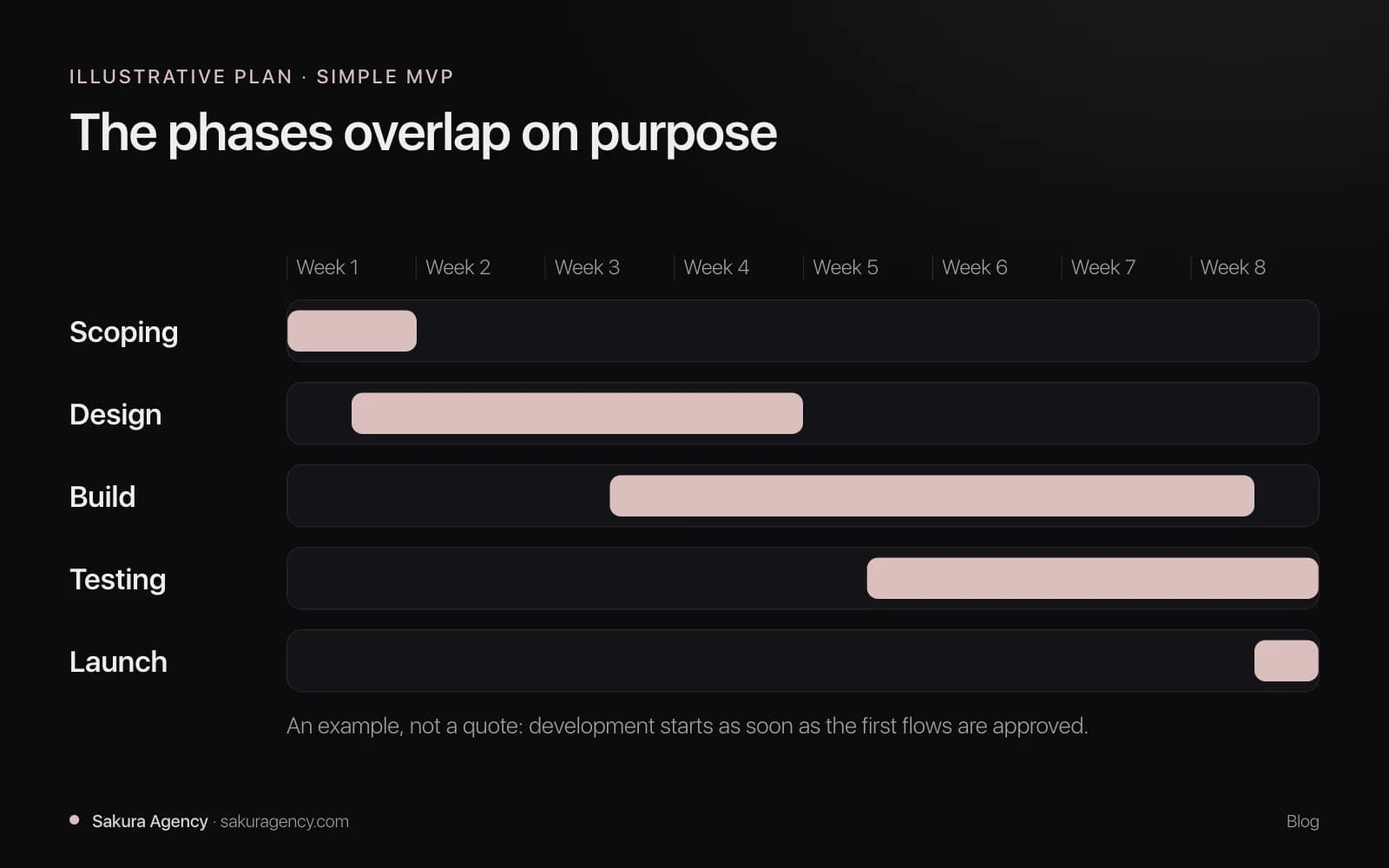
Design and build overlap on purpose. Once the first flows are approved, development starts on them while the remaining flows are still being designed.
How long does design take compared with development?
Design usually starts first and finishes before development does, but the two should not run one after the other. When design hands over a finished file and walks away, the build often uncovers screens that are expensive to implement, and weeks go into rework.
The fix is to design in the same components the developers will build. Then an approved screen is close to built already, and questions get answered while they are cheap.
For example, AutoIntel, a B2B tool for the German used-car market, started with product design and an interactive prototype on sample listings. The client walked its team through the prototype and settled which fields and filters matter before the data pipeline was scoped. That order keeps the expensive part of the build focused on what the interface actually needs.
Planning a launch date? Send us a short brief and we will tell you which tier your product falls into and what a realistic timeline looks like.
What adds time to an MVP?
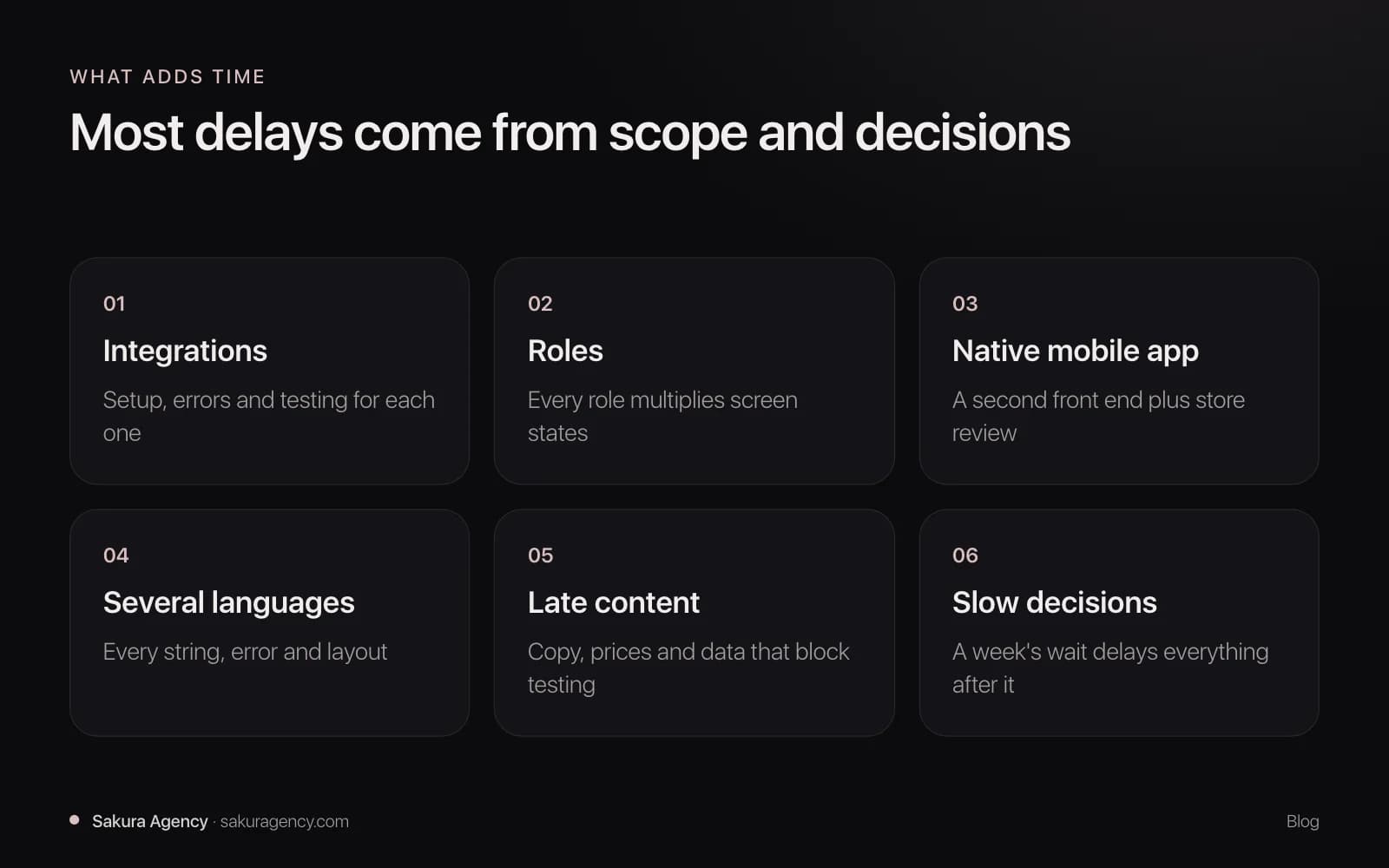
Some features look small in a brief and add weeks in the build. These are the ones to watch:
- Integrations. Payments, sign-in providers, CRMs and third-party APIs each bring setup, error handling and testing.
- Roles and permissions. Every additional role multiplies the states each screen has to handle.
- A native mobile app. It adds a second front end and an app store review step. Apple's App Review handles at least 50% of submissions in less than 24 hours and 90% in less than 48 hours, but a rejection restarts the clock.
- Multiple languages. Every string, error message and help text has to exist in each language, and layouts must fit the longest one.
- Late content. Copy, prices, legal texts and real data that arrive in the last week block testing.
- Slow decisions. A question that waits a week for an answer delays everything built on top of it.
How can you launch sooner without cutting quality?
You shorten an MVP timeline by doing less, not by doing it worse. These decisions save the most time:
- Cut whole flows, not polish. Move secondary flows to a later release instead of building every flow halfway.
- Launch on the web first. A responsive web app reaches phone and desktop users and skips app store review.
- Use proven services. Hosted checkout, existing sign-in providers and email services are faster and safer than custom versions.
- Decide fast. Name one person who can approve designs and answer questions within a day.
- Test early with a few users. Jakob Nielsen's research found that testing with 5 users reveals most usability problems, so several small rounds beat one large one.
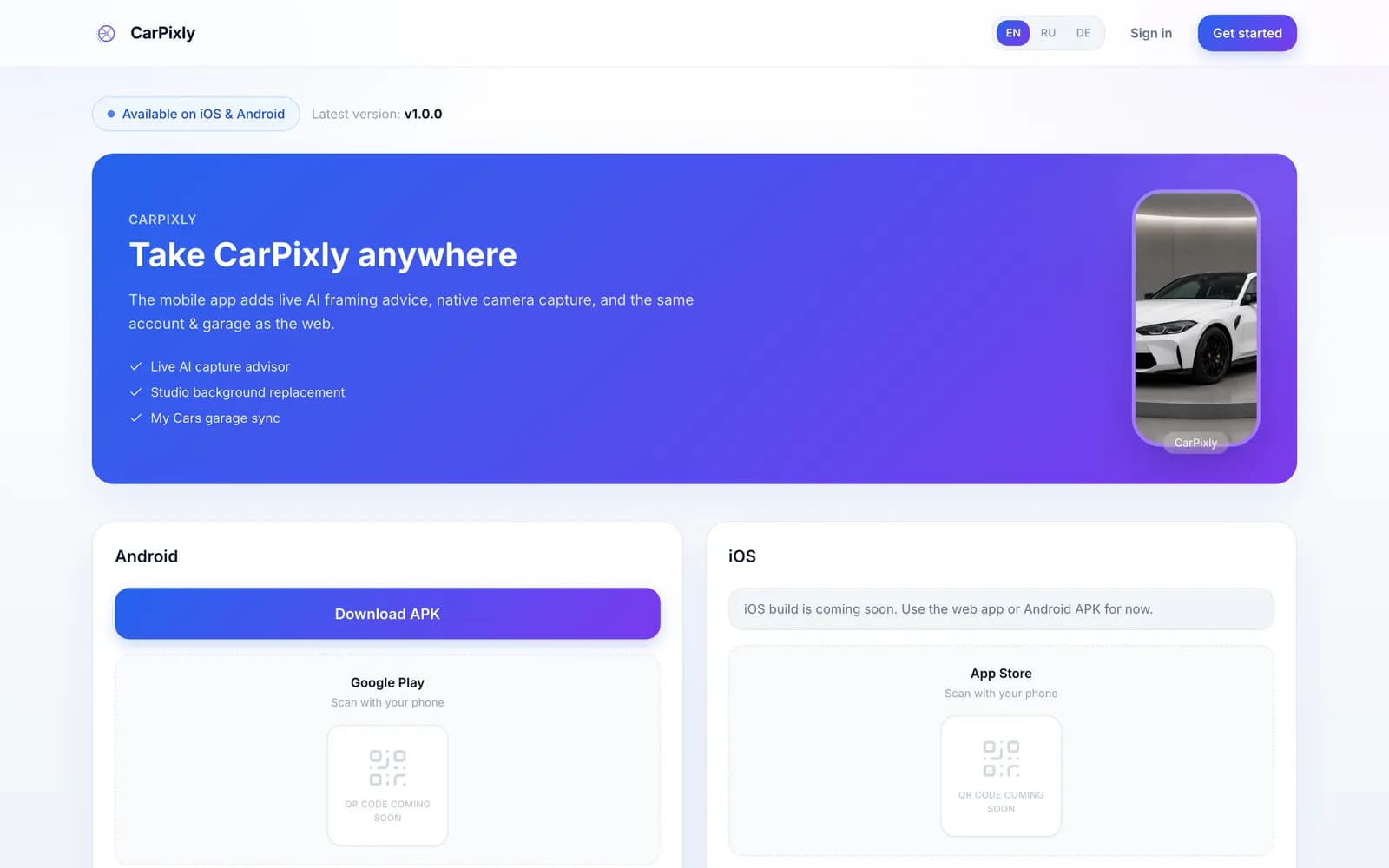
CarPixly, an AI photo studio for car listings, shipped Android as an APK from its own download page while the iOS build was still on its way. Launching where you can, and adding platforms later, is often the fastest route to real users.
What should you prepare before the project starts?
The first weeks go faster when a few things are ready before kickoff. None of them needs a technical background:
- A short list of core flows. The one to three jobs users must be able to do at launch, in plain words.
- One decision-maker. A person who can approve designs and answer questions within a day.
- Access to existing accounts. Domain, hosting, analytics, payment provider and any APIs you already use.
- Real content, or a date for it. Texts, prices, legal pages and sample data that the product will show.
- Your launch constraint. The event, investor meeting or season that makes the date matter.
With these in hand, scoping takes days instead of weeks, and the design phase can start on real content instead of placeholders.
Why do MVP timelines slip?
Timelines rarely slip because developers type slowly. They slip because of decisions made, or not made, around the build:
- Scope that grows mid-project without a written change process.
- Feedback rounds that take a week instead of a day.
- A definition of "done" that nobody wrote down, so the last weeks turn into a debate.
- Integrations planned as one line in the scope instead of their real edge cases.
A fixed scope with a change process keeps most of this under control. We explain how in fixed price vs. hourly development.
What happens to the timeline after launch?
Launch is the start of a second clock, not the end of the first. The first weeks after release are usually the busiest of the whole project.
Real users find bugs that testing missed, ask for small changes and use the product in ways nobody planned. Plan for a short period of fixes and quick improvements straight after launch, before any new features.
After that, work moves to a steady rhythm: a monthly plan of improvements based on what real usage shows. Every Sakura project includes a defined support window for bug fixes, and ongoing work can continue on a monthly plan or move to your own team.
How long should an MVP take before you launch it?
As short as it can be while still testing your main assumption. The point of an MVP, in the Lean Startup's words, is "to begin the process of learning as quickly as possible".
If your plan runs well past the complex tier, ask what you are trying to learn and whether a smaller product could teach you the same thing. Often a single flow, launched sooner, answers the question that matters most.
When you are ready to plan yours, tell us about your product. You will get a proposal with scope, timeline and a fixed price, and a weekly build to watch it come together.
FAQ
- Can you build an MVP in 4 weeks?
Only for a very narrow product built mostly on existing services. Most MVPs with real accounts, data and testing need at least 6 weeks; a clickable prototype is often the better 4-week goal.
- How long does it take to build a mobile app MVP?
A native mobile MVP usually lands in the mid or complex tier, so 8 to 14 weeks or more, plus app store review. Launching a responsive web app first is often faster.
- Does a fixed deadline make an MVP more expensive?
A compressed deadline does, because more people have to work in parallel and coordination costs time and money. A realistic deadline with a smaller scope is usually cheaper.
- What can I do to speed up my MVP?
Decide your core flows before the project starts, answer questions within a day and provide content early. These three habits save more time than any tool.
- How long does it take to get a proposal?
It depends on how complete your brief is. At Sakura, most proposals go out within 2–3 business days of a completed brief.
About the author
Vladimir Kurilo
Co-founder of Sakura Agency. Leads product and business.