How to Choose a Development Agency (Without Regretting It in 6 Months)

To choose a development agency, check three things before you compare prices: live products you can open, the names of the people who will build yours, and a proposal that lists exclusions and a change process. An agency that passes all three is a serious option; one that fails any of them is a risk, whatever it charges.
Most bad agency experiences are predictable from the first two calls. This guide shows what to check, what to ask and which answers should make you walk away.
Key takeaways
- Decide what outcome you are buying before you talk to anyone, so you can tell which agency answers your question.
- Judge an agency by products you can open and test, not by mockups in a portfolio.
- Ask who will design, build and manage your project, and meet them before you sign.
- Compare proposals line by line: inclusions, exclusions, change process, payments and support after launch.
- Treat the sales process as a preview of the project. Slow answers and blanket agreement rarely improve after you pay.
What should you decide before you contact agencies?
Write down what you are buying. Not the feature list, but the outcome: a working MVP to show investors, a rebuild of a product that has hit its limits, or a design system your own team can extend.
Add four practical facts to that outcome:
- The one to three things users must be able to do at launch.
- Your deadline, and what happens if you miss it.
- A budget range you can actually spend.
- Who on your side will make decisions and review work every week.
The clearer this is, the easier it becomes to spot an agency that is answering a different question from the one you asked. It also makes proposals from different agencies comparable.
How do you check an agency's shipped work?
A portfolio of polished mockups tells you an agency can design. It does not tell you it can ship. Ask for live products you can open, and for case studies that explain the problem and what changed.
Then test the live products yourself. Open them on your phone, click through the main flow and run them through Lighthouse, Google's free tool for performance, accessibility and SEO audits.
Google's Core Web Vitals give you clear targets to compare against: the main content should load within 2.5 seconds, interactions should respond within 200 milliseconds, and layout shift should stay at 0.1 or less.
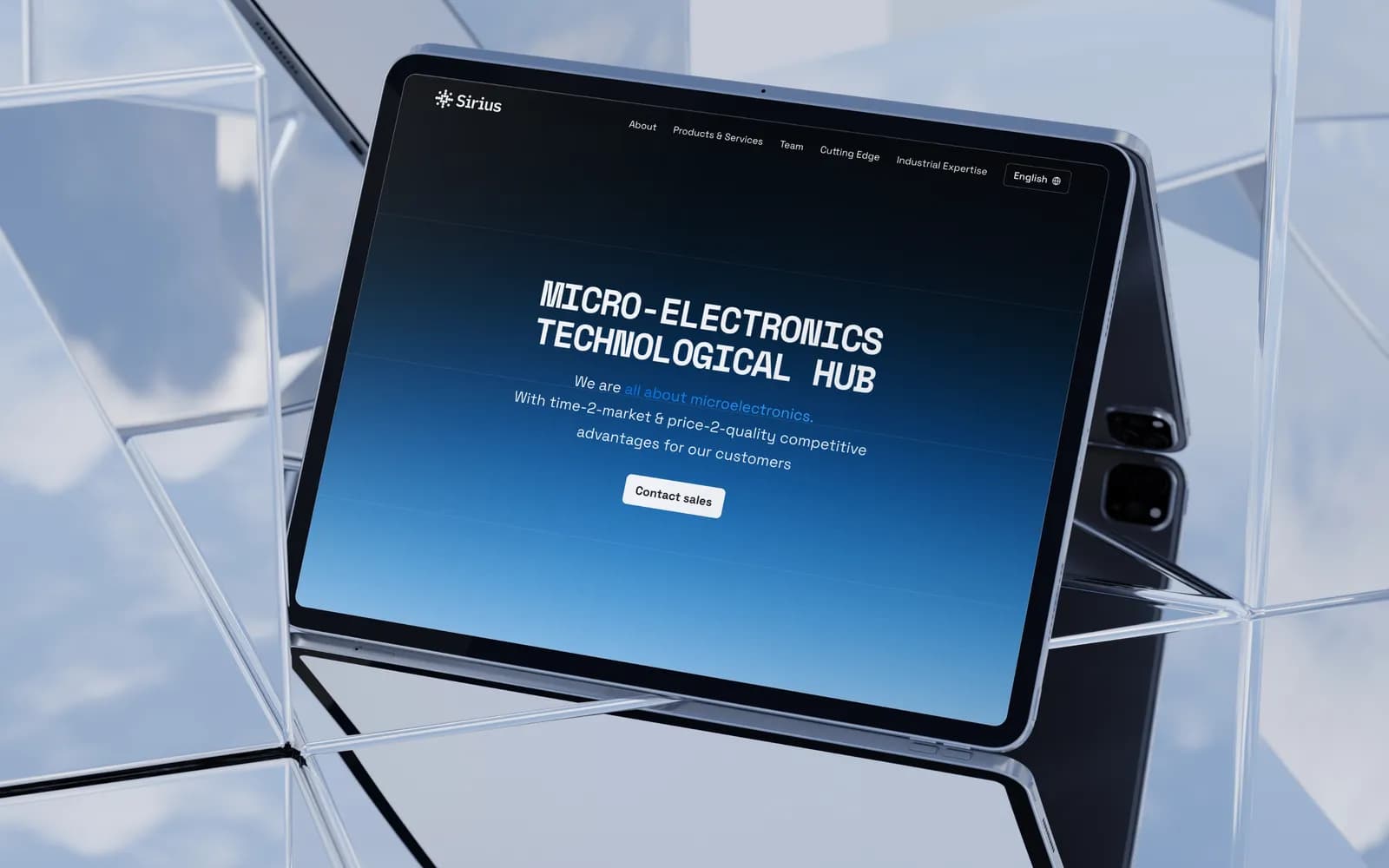
For example, Sirius Semiconductors is a microelectronics hub whose site had to win over international buyers in a second language. You can open the live site from the case page and judge the result yourself, which is exactly what you should be able to do with any agency's work.
If a lot of the work cannot be shown, ask why. An NDA on some projects is normal. An NDA on all of them is a signal.
Who will actually work on your project?
The people on the sales call are not always the people on your project. Ask directly: who designs it, who builds it, and who is your contact day to day? Ask to meet them before you sign.
Watch for the classic handoff, where a senior team pitches and a junior team delivers. It is not automatically bad, but you should know about it up front, not discover it in week three.
At Sakura, a co-founder or the tech lead runs every project and answers to you for the result. Whatever agency you choose, get the equivalent answer in writing: one named person who owns delivery.
How do design, development and launch connect?
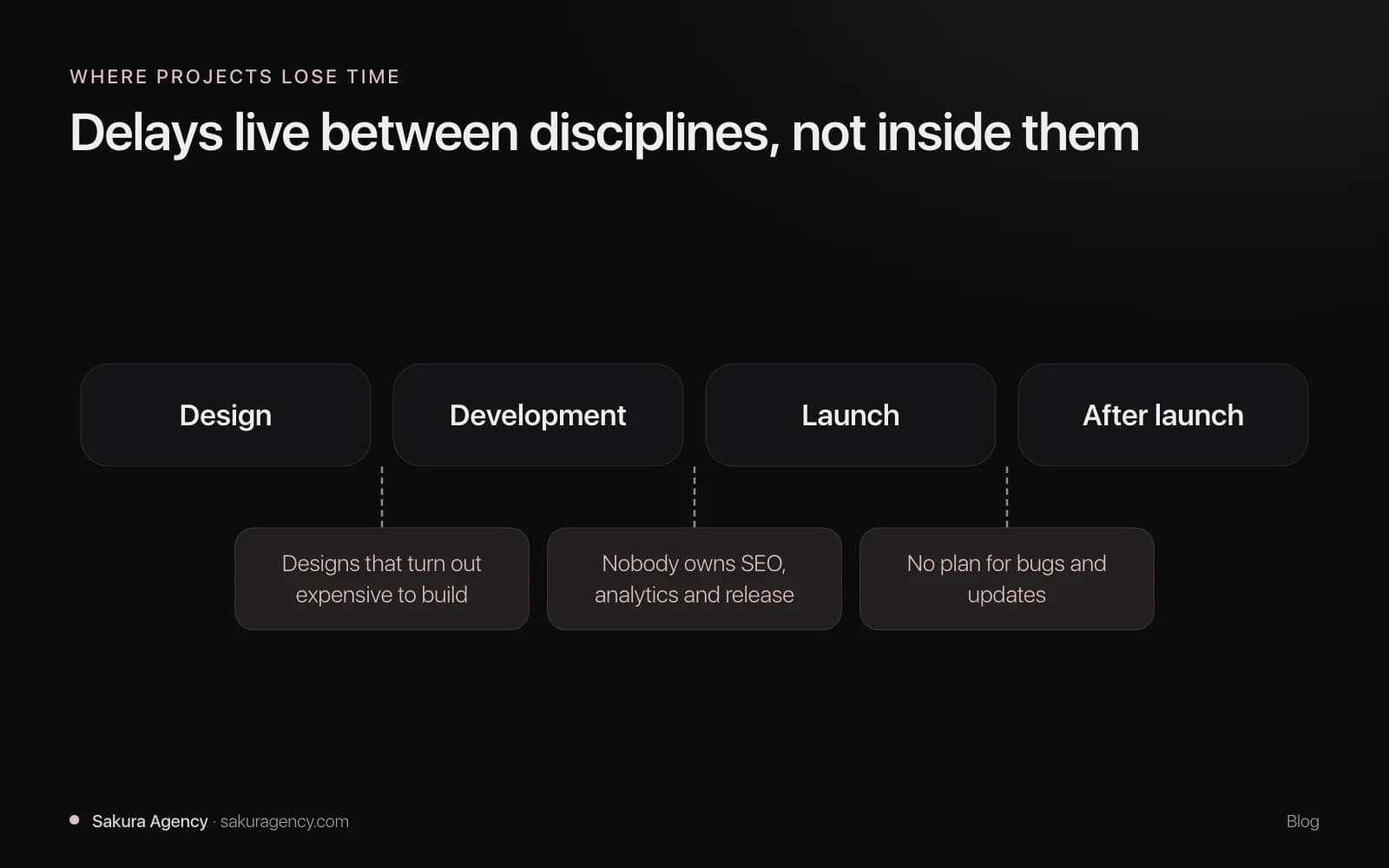
Most delays happen in the gaps. Between the designer's file and the developer's build, or between launch day and whoever is supposed to handle fixes and SEO afterwards.
Ask three questions and listen for specifics:
- Does the same team design and build, or is design handed to another company?
- What happens when a design turns out to be expensive to implement?
- Who looks after the product once it is live, and how is that priced?
Specific answers mean the agency has hit these problems before and has a way of dealing with them. Vague answers mean you will be the one dealing with them.
ProAnalizy, a service that explains lab results in plain language, shows why this matters. The upload is the only heavy interaction, so the rest of the first screen renders before any scripts load, and page titles use the test names people actually search for. Those were design, engineering and SEO decisions at the same time.
How do you compare proposals from different agencies?
Two quotes with the same number can describe completely different projects. Compare them line by line, not by the total.
| What to compare | A strong proposal | A weak proposal |
|---|---|---|
| Scope | User flows described as outcomes | A list of module names |
| Exclusions | Listed explicitly | Not mentioned |
| Changes | A written process to estimate and approve them | "We will be flexible" |
| Payments | A deposit, then milestones you can check | Most of the money up front |
| Progress | Working builds on a test link every week or two | A demo at the end |
| After launch | A defined support window, then an optional plan | Nothing after launch day |
| Ownership | Code and accounts in your name | Not addressed |
A proposal that is vague about exclusions is not cheaper. It moves the cost to later, when you have less room to negotiate. Our guide on how to read a development proposal walks through each section in detail.
The pricing model matters too. We compare both common models in fixed price vs. hourly development.
Comparing a few offers right now? Send us your brief and you will get a proposal you can put next to the others, line by line.
What does the sales process tell you about the project?
How an agency behaves before you pay is the best preview of how it behaves after. Watch for a few signals:
- How fast and how clearly do they answer?
- Do they ask about your users and your business, or only about features?
- Do they push back when something in your brief does not make sense?
An agency that agrees with everything on the first call will usually keep agreeing, right up until the deadline slips. Good agencies say "no" or "not yet" early, and explain why.
Pay attention to what they ask you, too. An agency that asks about your budget range, your users and your deadline is trying to shape the scope to your situation, not to its standard package.
How do you check an agency's references?
Ask for one or two past clients you can talk to, ideally on projects similar to yours. A short call tells you more than any testimonial on a website.
Keep the questions specific, so the answers are hard to polish:
- What went wrong during the project, and how did the agency handle it?
- Did the final cost match the proposal? If not, why?
- Who did you work with day to day, and were they the people from the first call?
- Would you hire them again for your next product?
Listen for how they describe problems, not whether there were any. Every real project has problems. A reference who says "they told us early and fixed it" is worth more than one who says "everything was perfect".
If an agency cannot offer a single reference, ask why. New agencies may have fewer, but they should still be able to connect you with someone who has seen their work up close.
Does the agency need to be in your country?
Not necessarily. What matters is overlap in working hours, a shared working language and a clear rhythm of updates, not the address on the contract.
Remote teams work well when the process is explicit: agreed channels, regular calls in overlapping hours and progress you can see without asking. Sakura works this way with founders in different countries, using written updates and calls in the hours both sides share.
There are cases where a local partner helps: for example, when your product depends on local regulations, payment methods or language nuances your team cannot check. In that case, ask the agency how it will cover those details, and who on its side knows the market.
Which red flags should make you walk away?
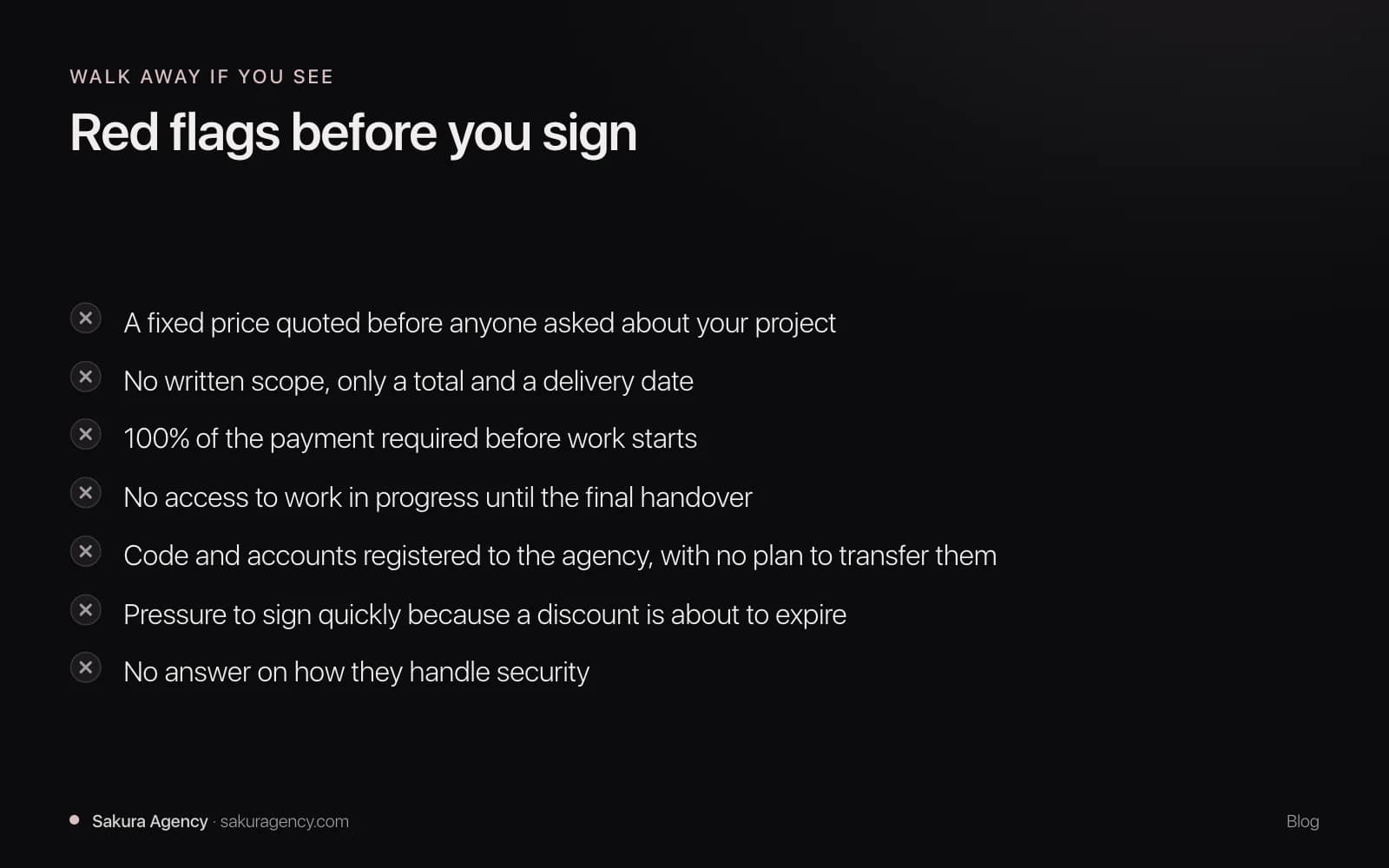
Some answers should end the conversation, however good the price looks:
- A fixed price quoted before anyone has asked about your project.
- No written scope, only a total and a delivery date.
- 100% of the payment required before work starts.
- No access to work in progress until the final handover.
- Code, hosting or app store accounts registered to the agency, with no plan to transfer them.
- Pressure to sign quickly because a discount is about to expire.
- No answer to how they handle security, such as the risks in the OWASP Top 10.
What should you check before you sign?
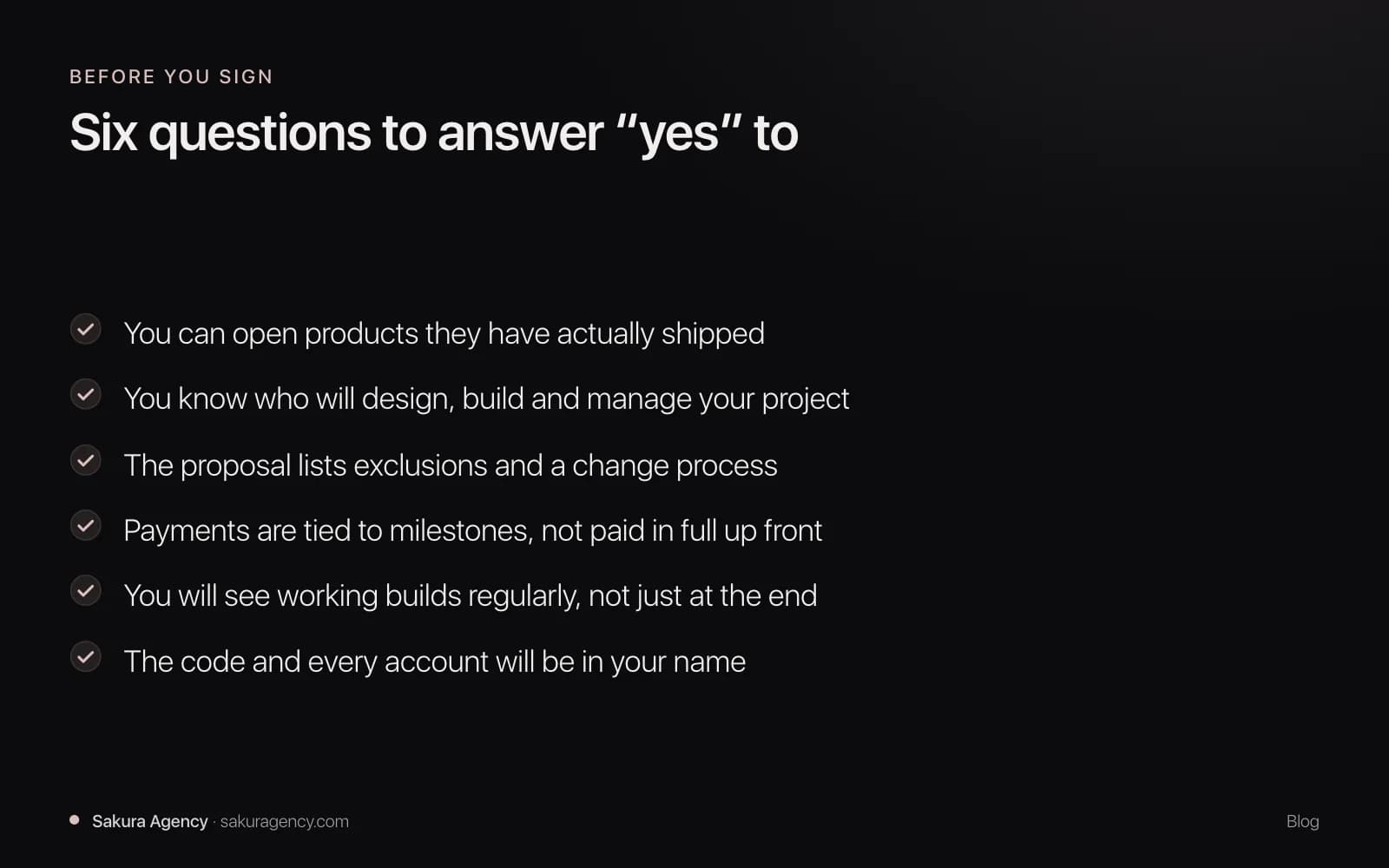
Run through this checklist with the agency you are about to choose. If you can answer yes to all of it, you are comparing serious options.
- Can you open at least a few products they have actually shipped?
- Do you know who will design, build and manage your project?
- Does the proposal list exclusions and explain how scope changes are handled?
- Are payments tied to milestones rather than paid in full up front?
- Will you see working builds regularly, not just at the end?
- Will the code and every account be in your name?
From there, fit and communication decide the rest. Choose the team you would be comfortable calling with bad news, because at some point in every project, someone has to.
If you want to see how we answer these questions, tell us about your project. You will get specific answers and a fixed proposal, not a sales deck.
FAQ
- How many agencies should I talk to?
Three is usually enough to compare proposals properly. More than five turns into a full-time job and rarely changes the decision.
- Should I choose the cheapest proposal?
Only if it describes the same scope as the others. Compare inclusions, exclusions and the change process first; a low total with a vague scope usually costs more by the end.
- Is it a bad sign if an agency uses contractors?
Not by itself. What matters is who owns delivery, whether you know who will work on your project, and whether the code and accounts end up in your name.
- How do I check the quality of an agency's code if I am not technical?
Test their live products with Lighthouse, ask how they handle testing and security, and ask whether the code will be documented for another developer. A short paid audit by an independent engineer is also a sound investment.
- What should I do if an agency refuses to share live work?
Ask why. An NDA on some projects is normal, but if nothing can be shown or described, treat it as a serious warning sign.
About the author
Vladimir Kurilo
Co-founder of Sakura Agency. Leads product and business.