How to Validate a Startup Idea Before You Build Anything

Co-Founder, Product & Business
To validate a startup idea, find evidence that a specific group of people has the problem, already spends time or money on it, and will commit something real before you build: a pre-order, a deposit, a signed pilot or at least a calendar slot. Conversations, a landing page and a clickable prototype can give you that evidence for a fraction of what an MVP costs.
Validation is not about proving yourself right. It is about finding out cheaply whether you are wrong, before you spend months and most of your savings on a product.
This guide walks through the steps in order, from the first conversation to the moment you decide to build or to stop.
Key takeaways
- Pick one narrow group of people with the problem; "everyone" is not a market you can test.
- Ask about what people did in the past, not what they would do in the future.
- Treat compliments and signups as weak signals; pre-orders, deposits and pilots as strong ones.
- Test demand with a landing page and a clickable prototype before you write production code.
- Decide in advance what result means "build" and what result means "stop".
What does it mean to validate a startup idea?
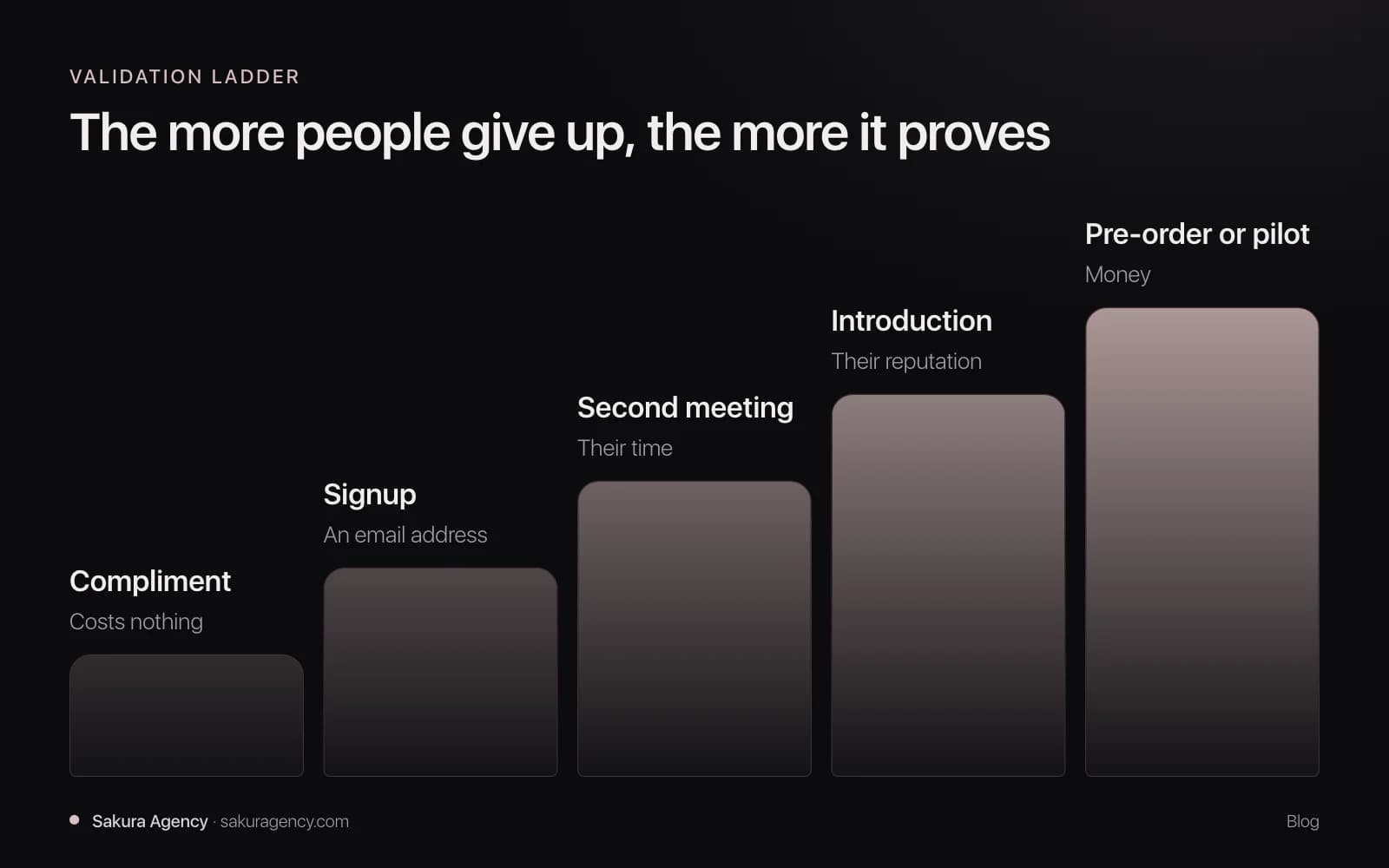
An idea is validated when you have evidence, not opinions, that people want the solution enough to act. The evidence gets stronger as people give up more: time, reputation, money.
Think of it as a ladder. Each step costs you a little more to test and gives you a more reliable answer.
| Signal | What people give | How much it proves |
|---|---|---|
| "Great idea!" | Nothing | Almost nothing |
| A newsletter or waitlist signup | An email address | Some interest |
| A second meeting or a demo request | Their time | Real interest |
| An introduction to a colleague or their boss | Their reputation | A real problem |
| A pre-order, deposit or paid pilot | Money | Demand |
The goal is to climb this ladder as far as you can before you build the product itself.
Who exactly has the problem?
Validation starts with a narrow group. "Small businesses" is too broad to test; "independent dog groomers who book clients by phone" is a group you can find, call and learn from.
Write one sentence that names the group, the problem and the current workaround. For example: "Independent dog groomers lose bookings because they cannot answer the phone while they work, so they call back in the evening."
If you cannot write that sentence yet, you are not ready to test a solution. Spend the first week finding out who suffers most from the problem you have in mind.
How do you talk to customers without fooling yourself?
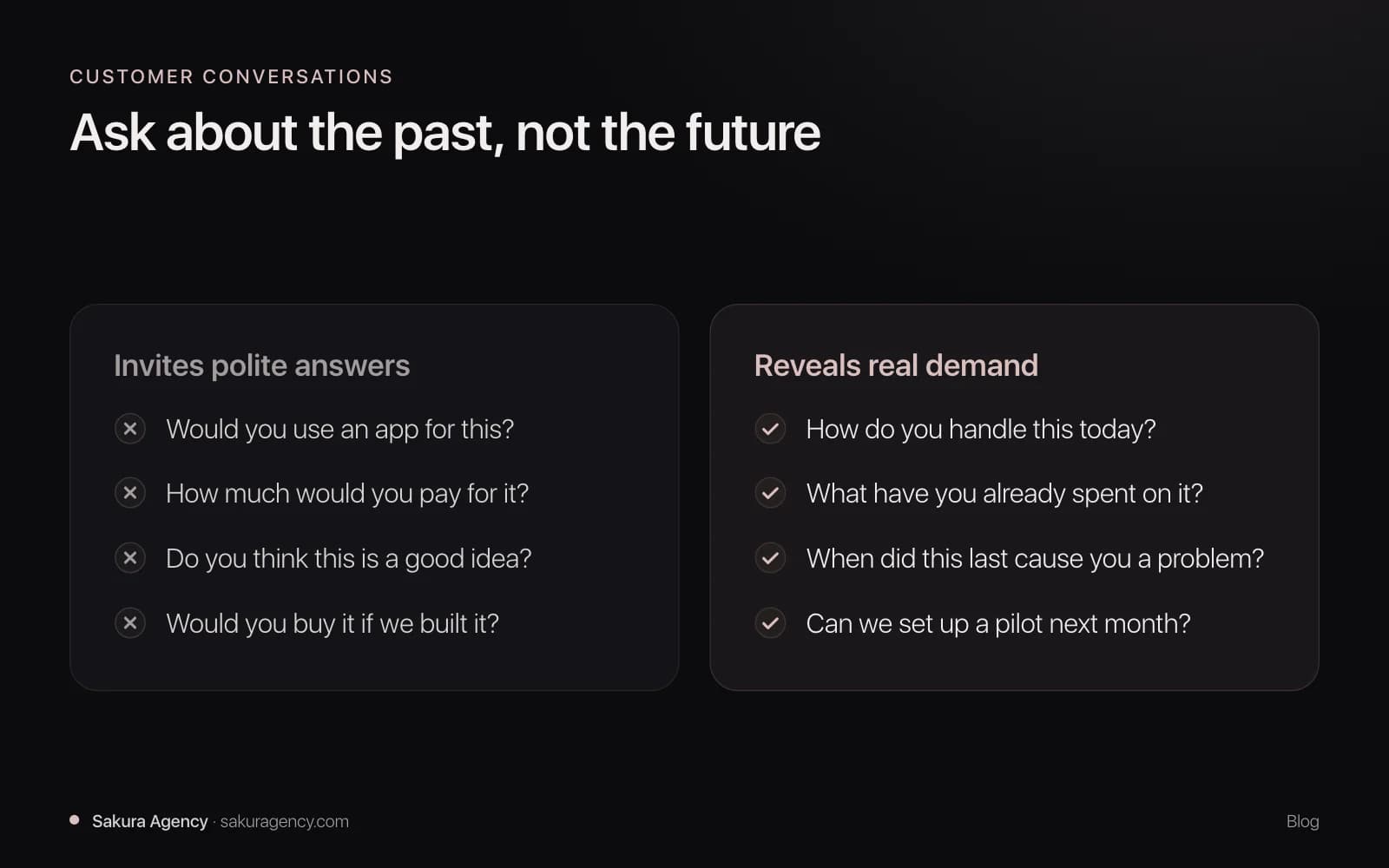
Most founders ask questions that invite polite lies. "Would you use an app that does this?" gets a yes from almost everyone and tells you nothing.
Rob Fitzpatrick's book The Mom Test is built around this trap: people are naturally inclined to be kind about your idea. The fix is to ask about their life and past behaviour, not about your idea.
| Instead of asking | Ask |
|---|---|
| Would you use an app for this? | How do you handle this today? |
| How much would you pay for it? | What have you already spent trying to solve it? |
| Do you think this is a good idea? | When did this last cause you a problem, and what happened? |
| Would you buy it if we built it? | Can we set up a pilot next month? |
Listen for specifics: dates, amounts, tools, names. "Last Tuesday I lost two bookings" is a fact. "It would be nice to have" is a feeling.
How do you find people to talk to?
You go and get them. Paul Graham's essay Do Things That Don't Scale makes the point directly: "You can't wait for users to come to you. You have to go out and get them."
In practice, early conversations come from a few places:
- Communities where your group already talks: forums, chats, professional groups, local associations.
- Your second-degree network: ask people you know to introduce you to someone with the problem.
- Direct, short messages to people with the right job title, explaining that you are researching, not selling.
- Events and places where your group works, if your product serves an offline business.
Aim for conversations with people who have the problem and no reason to be kind to you. Friends and family are useful for practising your questions, not for evidence.
After a dozen conversations, patterns usually appear. If they do not, the group may be too broad, or the problem may not be painful enough to act on.
What signals show real demand?
Demand shows up as behaviour, not words. These signals are worth more than any number of positive conversations:
- People describe the problem before you mention it.
- They already pay for a workaround: a tool, a freelancer, extra staff hours.
- They ask when they can try it, without being prompted.
- They introduce you to a colleague or their manager.
- They agree to a pilot, a pre-order or a deposit.
You can also check market-level interest. Google Trends shows whether searches for the problem or its existing solutions are growing or shrinking. It will not validate your idea, but it can warn you about a shrinking market.
Weak demand is a common reason for failure. In CB Insights' 2026 analysis of 431 VC-backed companies that shut down since 2023, 43% had poor product-market fit.
How do you test demand with a landing page?
A landing page turns conversations into numbers. It should make one clear promise to one group and ask for one action, such as joining a waitlist, booking a call or placing a pre-order.
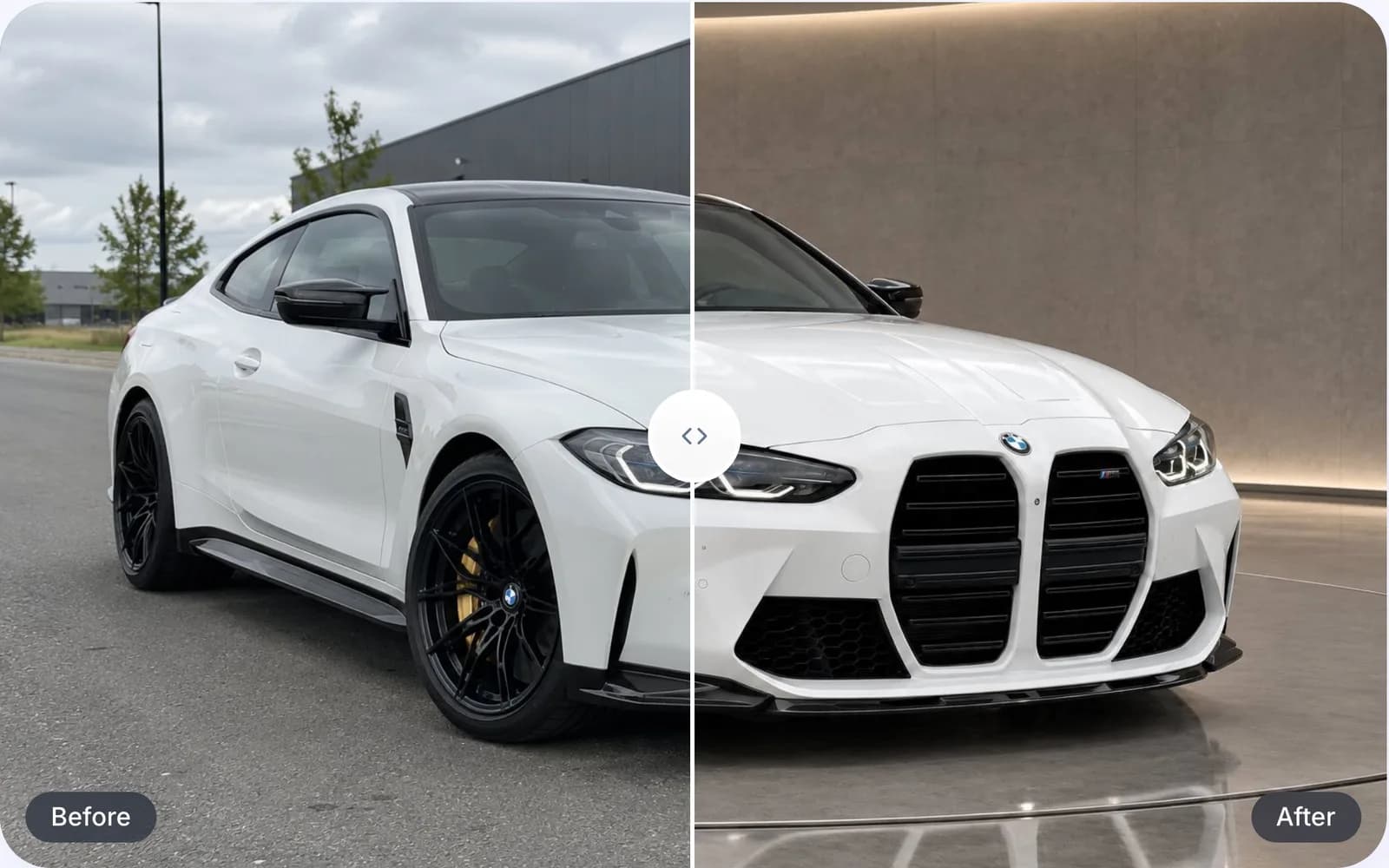
Show the result, not just the promise. CarPixly, an AI photo studio for car listings, opens with a before-and-after slider: a car in a car park on one side and the same car in a studio scene on the other. Visitors see what the product does in seconds.
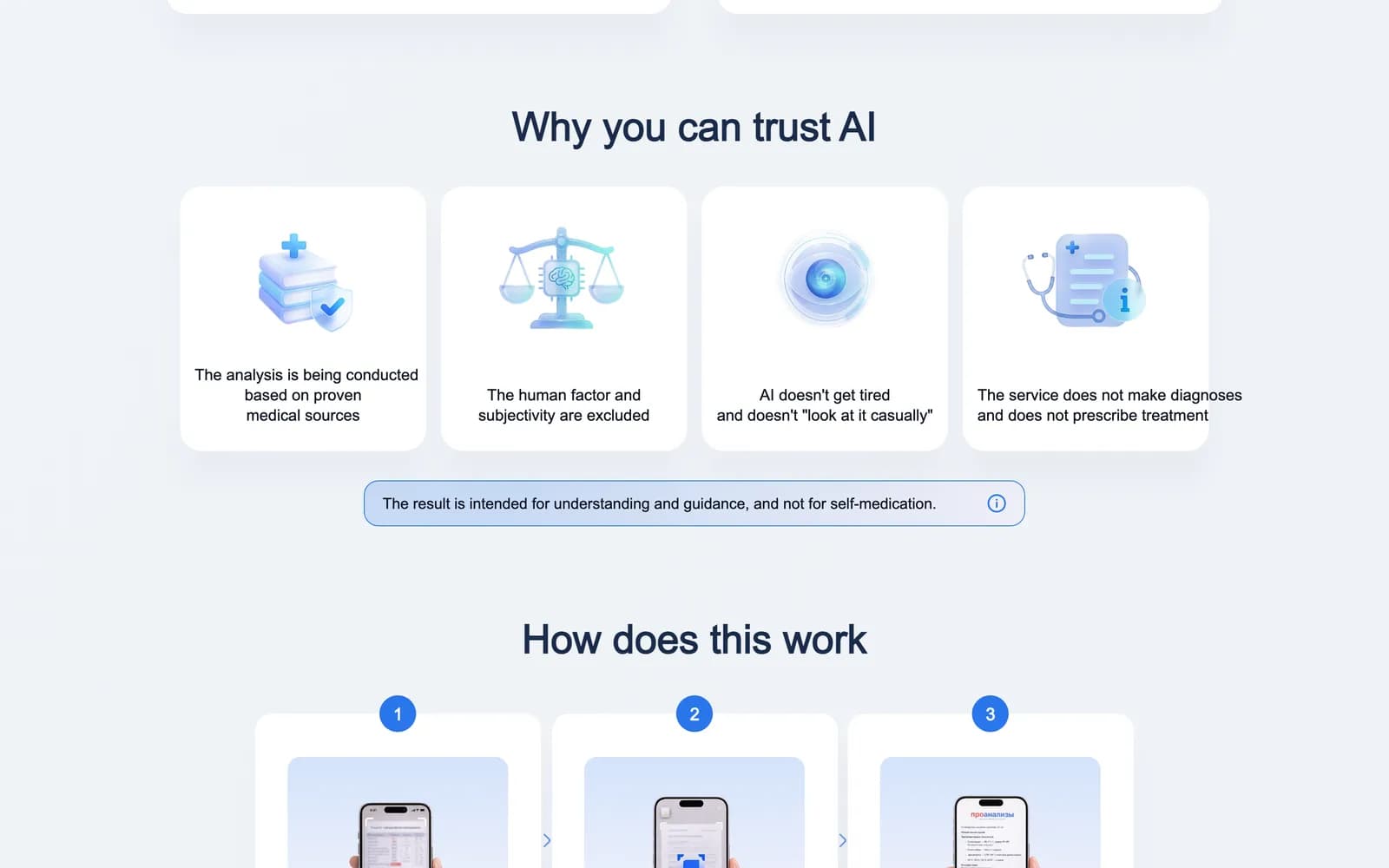
Answer the doubts that stop people from acting, right next to the action. ProAnalizy, which explains lab results in plain language, explains what the service does and does not do, and how it works in three steps.
Send the page to the group you interviewed and track one number: how many visitors take the action. Decide before you launch the page what rate would make you confident, so you cannot talk yourself into a weak result.
Want help turning your idea into a page and a prototype people can react to? Send us a short brief and we will suggest the cheapest test that answers your biggest question.
When should you build a prototype?
Build a prototype once conversations show a real problem and you need to know whether your solution makes sense to people. A clickable prototype lets them try the flow without you writing production code.
Test it with people from your group, give them a realistic task and watch where they get stuck. Our guide on MVP vs. prototype vs. proof of concept explains when each of the three is the right next step.
A prototype designed in real components is not wasted when you move on. Its flows and screens become the start of the product, which is how we approach product design from the first screen.
What does a validation sprint look like?
Validation works best in short, focused rounds. For example, a sprint for a new idea might look like this:
- First, define the group and the problem. Write the one-sentence description and list where you can find these people.
- Then talk to them. Hold as many conversations as you can, asking only about past behaviour.
- Then test the promise. Publish a landing page with one clear action and send it to the people you spoke with.
- Then test the solution. Put a clickable prototype in front of a few people and watch them use it.
- Finally, decide. Compare what you learned with the criteria you wrote down at the start.
Keep the rounds short. The longer validation takes, the more tempting it becomes to read every result as good news.
How do you know the idea is validated?
Set your criteria before you start testing. Write down what result means "build", what means "change the idea" and what means "stop". For example:
- Build if at least a few people from your group agree to a paid pilot or a pre-order.
- Change the idea if people confirm the problem but do not react to your solution.
- Stop if, after a dozen honest conversations, nobody has the problem badly enough to act on it.
These criteria protect you from the most expensive kind of bias: reading every result as encouragement. A clear "stop" after a few weeks is a good outcome. It saves the money an MVP would have cost.
How much should validation cost?
Much less than building. Conversations cost your time; a landing page and a clickable prototype cost a small part of an MVP budget.
For comparison, most SaaS MVPs cost $15,000 to $70,000 to build, as our breakdown of what a SaaS MVP costs shows. Spending a few weeks and a small budget to test the idea first is the cheapest insurance you can buy against building the wrong product.
When your tests point to "build", tell us about your product. We will help you scope the smallest version that proves the rest.
FAQ
- How many customer interviews do I need to validate an idea?
There is no fixed number, but patterns usually appear after a dozen conversations with people who have the problem. If they do not, narrow your group or rethink the problem.
- Is a waitlist signup enough to validate an idea?
No. A signup costs nothing, so it shows interest at most. Pre-orders, deposits, paid pilots and introductions to decision-makers are much stronger evidence.
- Can I validate an idea without building anything?
Yes. Conversations, a landing page and a clickable prototype test the problem, the demand and the solution before any production code exists.
- Should I ask friends and family for feedback?
Use them to practise your questions, not as evidence. They want to support you, so their answers are too kind to be reliable.
- What if validation shows the idea does not work?
That is a successful result. You have saved the cost of an MVP and learned enough to change the idea or move on to a better one.
About the author
Vladimir Kurilo
Co-founder of Sakura Agency. Leads product and business.