Copilot EGE — Exam prep that follows a route through the gaps, not the whole textbook
Copilot EGE is a learning platform for a tutoring school that prepares students for the EGE, Russia's national university entrance exam, in advanced mathematics. It finds out what a student already knows, builds a route through what is missing and shows tutors who needs help before the lesson starts. We designed and built the whole product: the student app, the tutor workspace and the company dashboard.
Challenge
Exam prep usually runs through the full syllabus whether a student needs it or not. A strong student spends weeks on topics they mastered years ago, a weaker one gets lost in topics they cannot start yet, and the tutor learns where a student is stuck only during the lesson, when half of it is already gone. The school also had no fair way to see which teaching worked: a tutor with weaker students always looked worse on raw scores.
Approach
We built the platform around a knowledge map of 24 exam topics and the links between them. A short diagnostic places every topic as known, shaky, unknown or not yet checked, and the route only includes what is missing, in an order where every topic has its prerequisites in place. The same data feeds three views: a student sees the next step, a tutor sees signals and typical mistakes, and the head of the school sees growth per tutor instead of raw scores.
A route instead of a syllabus
A new student starts with a diagnostic of 25 problems from the first part of the exam. From the answers, the platform marks every topic on the knowledge map and builds a personal route of about twenty topics: only the gaps, ordered so that nothing is attempted before the topics it depends on.
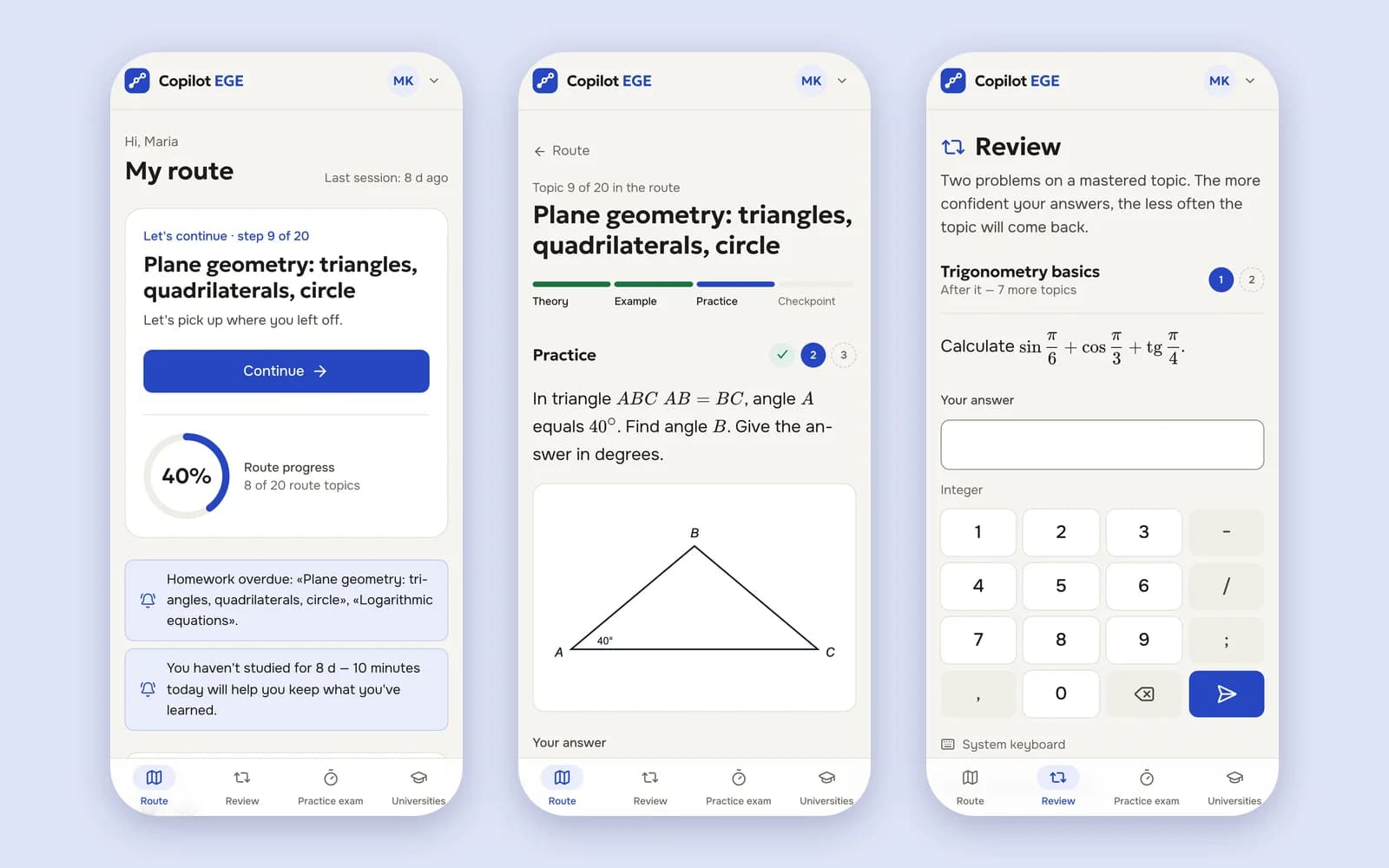
The student's home screen answers one question: what to do next. The current topic sits on top with a single Continue button and a ring showing how much of the route is done. Below it sit a weekly goal, a streak and a review counter, small reasons to come back tomorrow.
A knowledge map you can read
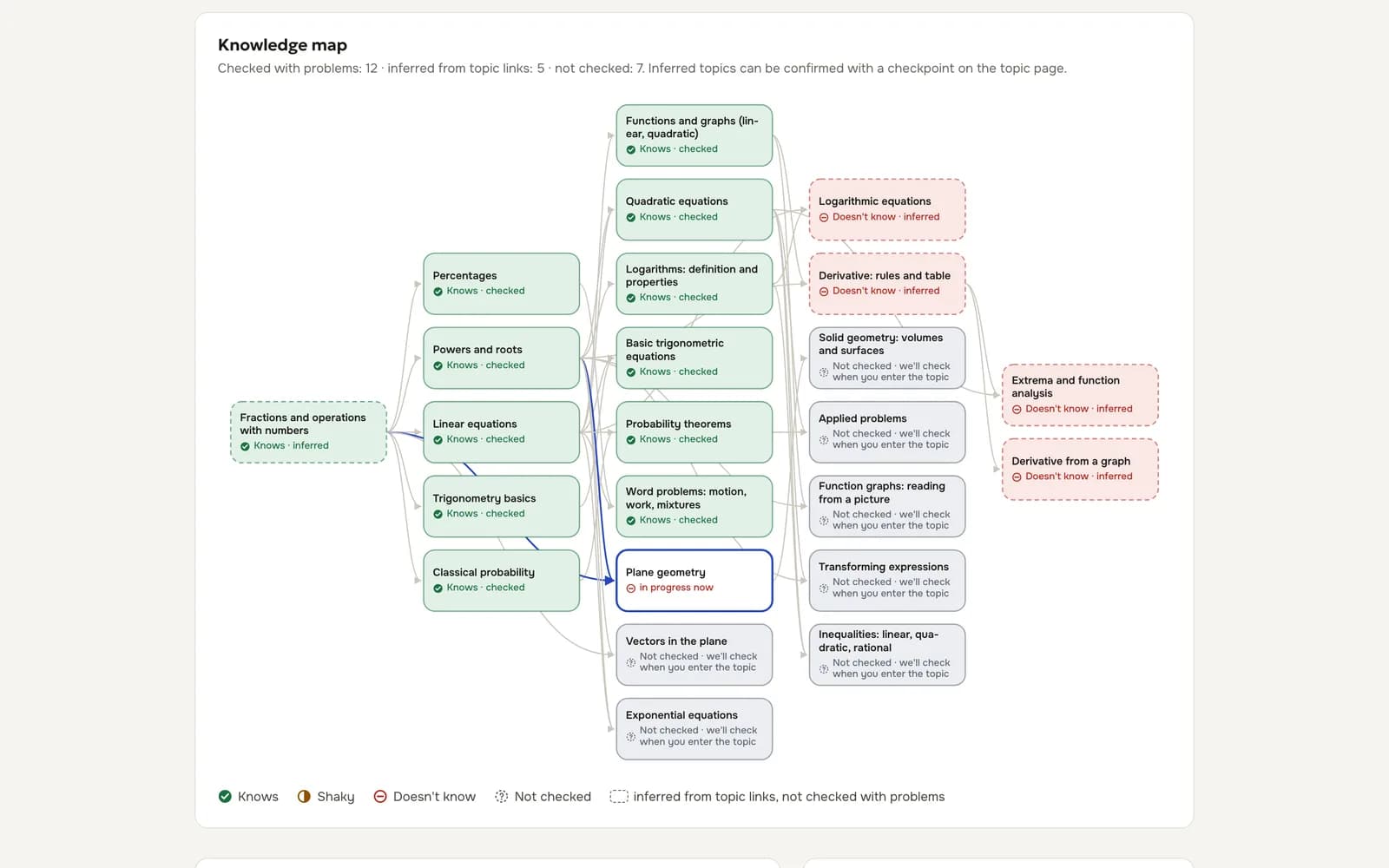
The knowledge map shows all 24 topics and how they connect, from fractions and percentages up to derivatives and solid geometry. Each topic carries two facts at once: what the student knows, and how the platform knows it.
- Checked means the student solved problems on the topic.
- Inferred means the platform deduced it from related topics.
- Not checked topics get a short check when the student reaches them.
Keeping inferred apart from checked matters: a guess never passes for a result, and any inferred topic can be confirmed with a checkpoint.
Every topic in four steps
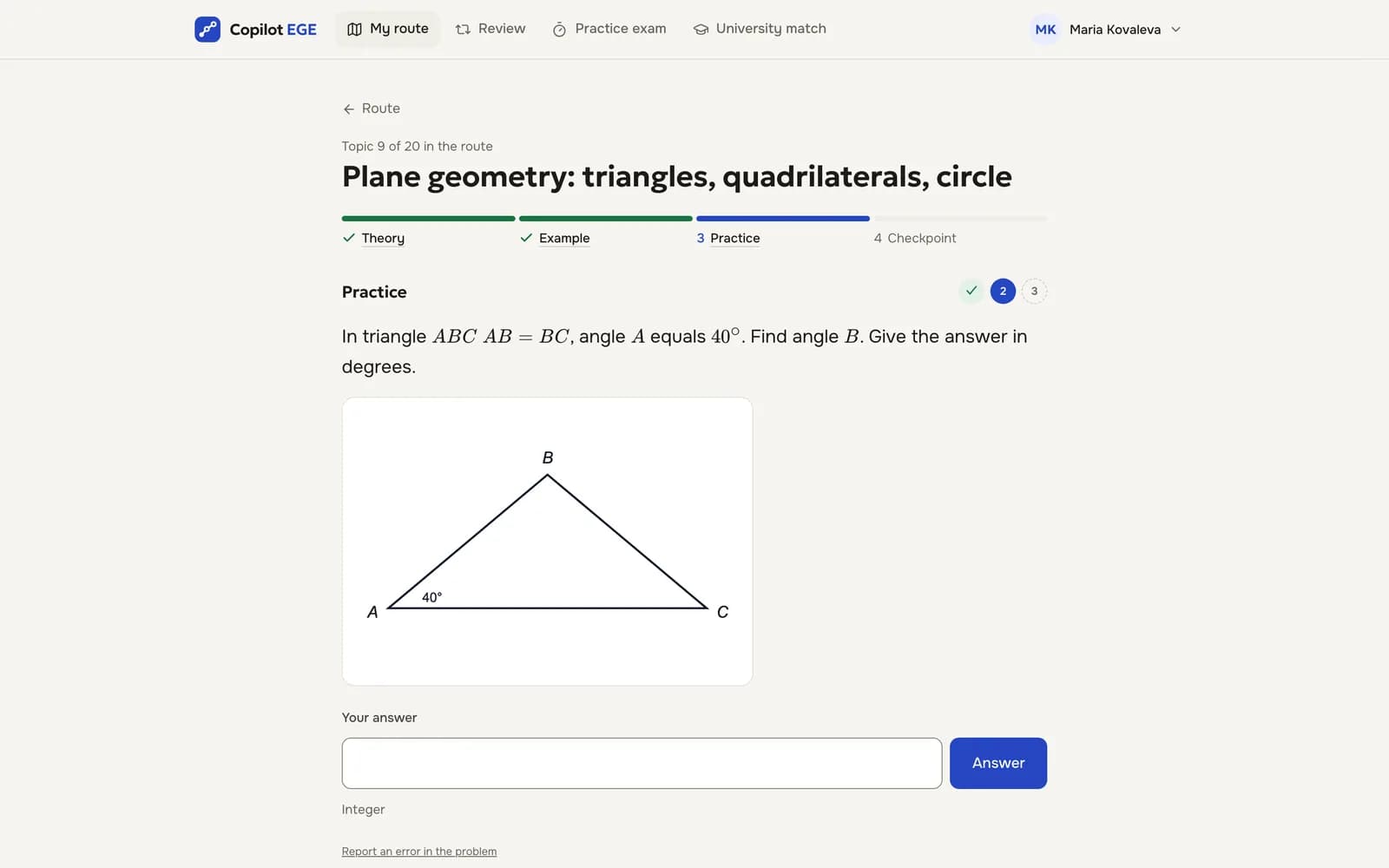
A topic moves through theory, a worked example, practice and a checkpoint. Problems use real exam formats with properly typeset maths and drawings, answers are checked automatically, and hints and step-by-step solutions open only when the student asks for them. On a phone, answers go in through a keypad built for maths, with fractions, minus signs and decimals one tap away instead of hidden in the system keyboard.
Mastered topics come back as short reviews of two problems. The more confident the answers, the less often a topic returns, so review time goes where memory is fading.
An AI assistant that stays on the subject
Inside every topic, a student can ask the AI assistant why an answer does not match or how a step works. The assistant answers from the platform's own theory and worked examples and cites the material it used, so its explanations match what the tutor teaches.
It also knows what it is not for. Questions outside exam maths get a polite redirect, and attempts to make it ignore its rules are refused. Every question a student asks is visible to their tutor, which shows exactly where the topic stopped making sense.
A tutor sees the problem before the lesson
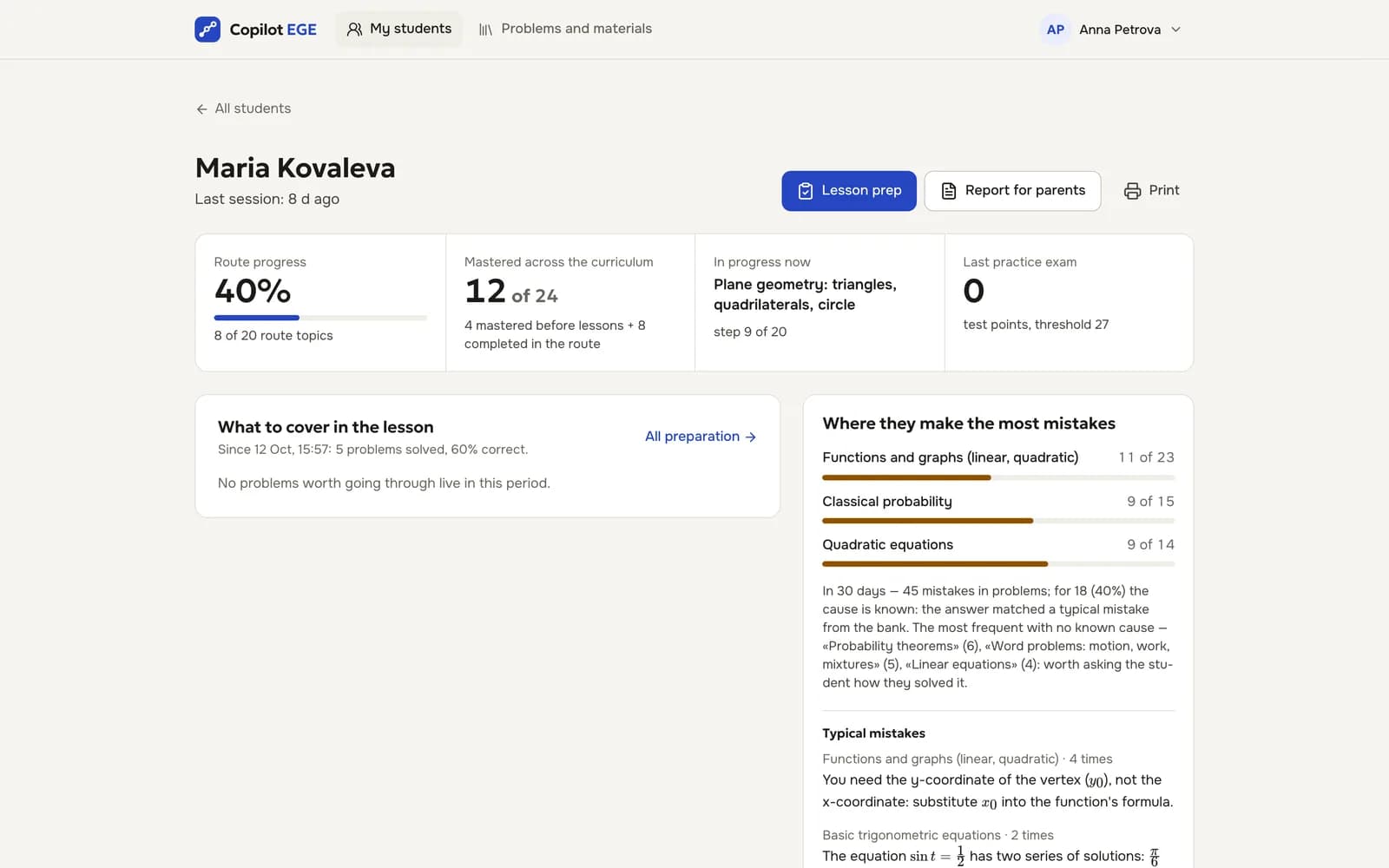
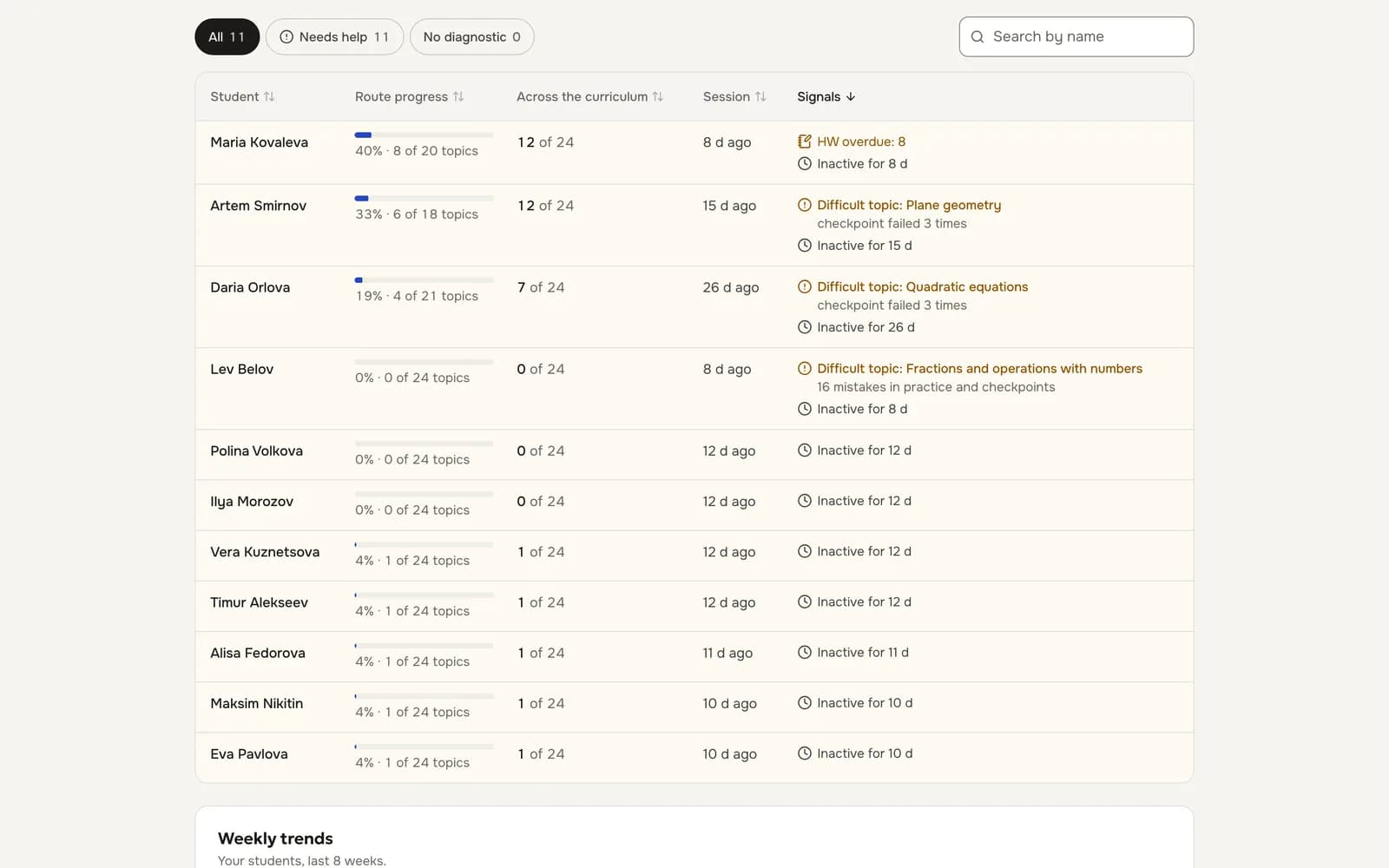
The tutor's list of students works as a set of signals rather than a gradebook: overdue homework, a topic where a checkpoint has failed three times, a student who has not studied for days. Filters separate those who need help from those who have not taken the diagnostic yet.
A student's profile prepares the lesson. It lists what is worth covering live, the topics with the most mistakes and the typical cause behind each one, matched against a bank of known mistakes, such as taking the x-coordinate of a vertex instead of the y-coordinate. From there, the tutor builds a lesson plan, sends homework on the weak topics and prints a report for parents.
A fair view for the head of the school
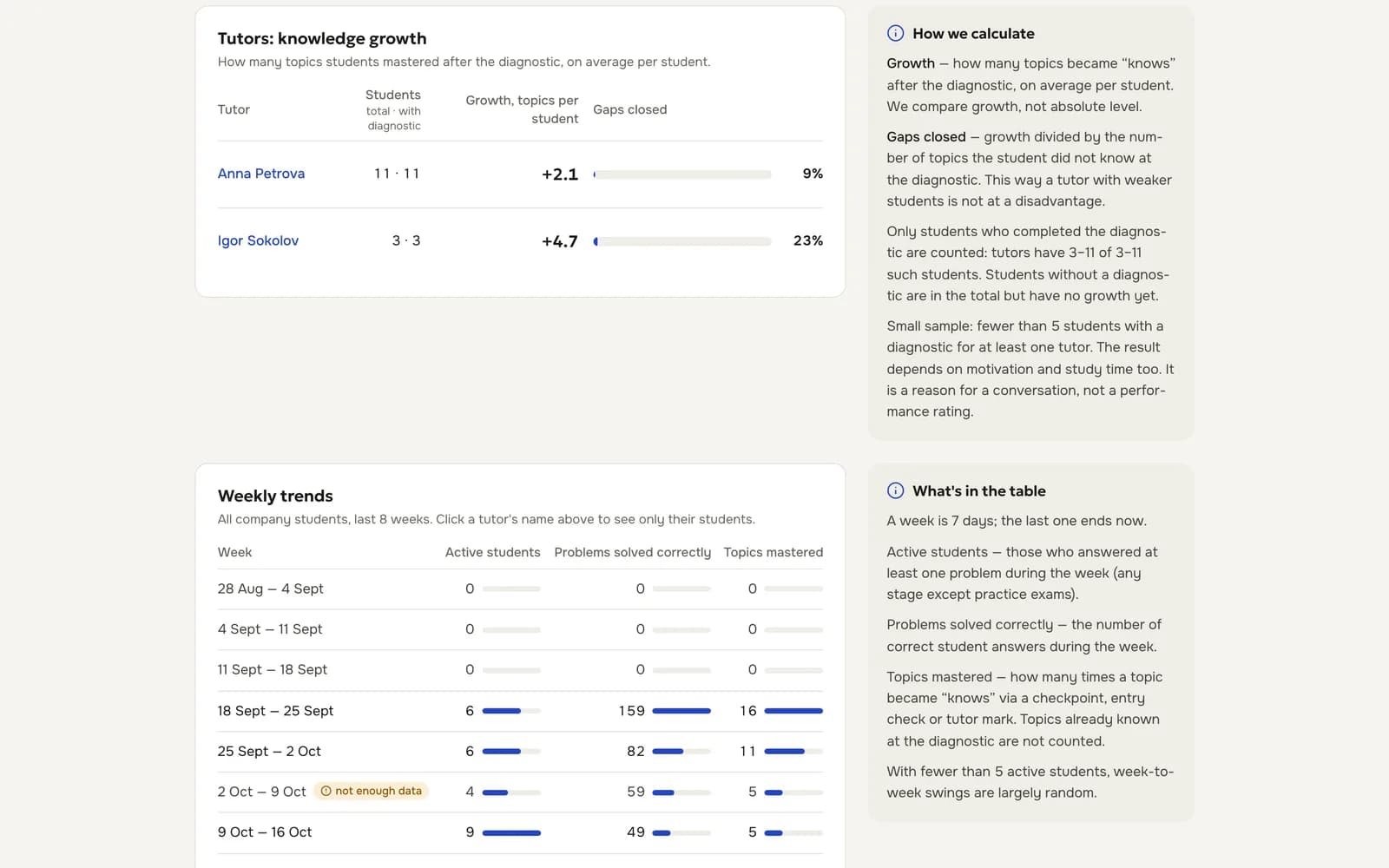
The company overview compares tutors by knowledge growth: how many topics a student mastered after the diagnostic, and what share of their gaps has closed. A tutor who takes on weaker students is not penalised for where those students started. Weekly trends, the hardest topics across the school, a printable report and CSV exports sit on the same screen.
Behind it, the content section manages a bank of more than two thousand problems, each with a status from draft to published, and collects error reports from students so a broken problem is fixed rather than silently skipped.
On a phone
Students study on the move, so the app is built phone-first. Navigation becomes four tabs at the bottom of the screen, the route card keeps its single button, and practice, review and the practice exam work fully on a small screen. The interface runs in Russian and English, with light and dark themes.
How we work on products like this
Copilot EGE combines our product design, web development and AI & automation. If you are planning a platform of your own, our guide to what a SaaS MVP costs shows where the budget goes. Building something for learners? Tell us about it.
What shipped
- Diagnostic of 25 problems and a personal route through the gaps only
- Knowledge map of 24 topics that keeps checked, inferred and unchecked apart
- Topics in four steps, spaced review, a practice exam and a maths keypad on the phone
- AI assistant that answers from the platform's materials and stays on the subject
- Tutor signals, lesson prep and parent reports, plus a school dashboard with growth per tutor
Frequently asked
A learning platform for the EGE, Russia's national university entrance exam, in advanced mathematics. It diagnoses what a student knows, builds a personal route through the gaps and gives tutors and school heads their own dashboards.
A 25-problem diagnostic marks each of the 24 exam topics as known, shaky, unknown or not yet checked. The route includes only the missing topics, in an order where each one's prerequisites are already in place.
It explains steps and answers questions inside a topic using the platform's own theory and worked examples, and cites them. It declines questions outside exam maths and does not change its rules on request.
The tutor sees signals for each student, such as overdue homework, repeated failed checkpoints or a long break, and a profile with typical mistakes, a lesson plan, homework on weak topics and a printable report for parents.
No. Students join by invitation from their tutor, and tutors and managers get accounts from the school.
Inside the site
“Our tutors used to spend the first twenty minutes of every lesson finding out what the student had forgotten. Now they open the profile and already know. Sakura understood that the platform had to work for three people at once, the student, the tutor and me, and each of us got exactly the screen we need.”