What Is a Discovery Phase in Software Development, and Is It Worth Paying For?

Co-Founder, Product & Design
A discovery phase is a short, paid stage before development where a team researches the problem, agrees what to build first and turns that into a scope, a plan and a price. It is worth paying for when the product has open questions that would otherwise be answered with expensive code.
Think of it as buying certainty before you buy software. A good discovery ends with documents you own and could take to any team, not just a nicer sales pitch.
This guide explains what happens in a discovery, what you should get at the end, how long it takes and when it is safe to skip.
Key takeaways
- A discovery answers the questions that make a quote unreliable: who the users are, which flows matter and what the risky parts are.
- You should finish with a written scope, user flows, a prototype or wireframes, a list of risks and a priced plan.
- A typical discovery for an MVP-sized product takes a few weeks, not months.
- Skip it only when the scope is small, clear and already written down.
- Insist that everything produced in discovery belongs to you, so you can take it to another team.
What is a discovery phase?
Discovery is the research and planning stage that comes before design and development. The team studies the problem, the users and the business goal, then decides what the first version must do.
Nielsen Norman Group describes discovery as a preliminary phase that involves "researching the problem space, framing the problem(s) to be solved, and gathering enough evidence and initial direction on what to do next". In plain terms: fewer guesses before money goes into code.
Agencies call it different names: discovery, inception, scoping or a product workshop. The label matters less than the result. If nothing written comes out of it, it was a series of meetings.
Why do agencies ask for a discovery before quoting?
Because a price is only as good as the scope behind it. When a brief says "a marketplace for tutors", two honest agencies can quote numbers that differ several times over, simply because they imagine different products.
A discovery replaces imagination with decisions: which user roles exist, which flows go into version one, which integrations are needed now and which can wait. Each answer removes a range from the estimate.
It also protects you on a fixed price. As our comparison of fixed price and hourly development explains, a fixed price only works when both sides agree on what is included. Discovery is where that agreement gets written.
What happens during a discovery?
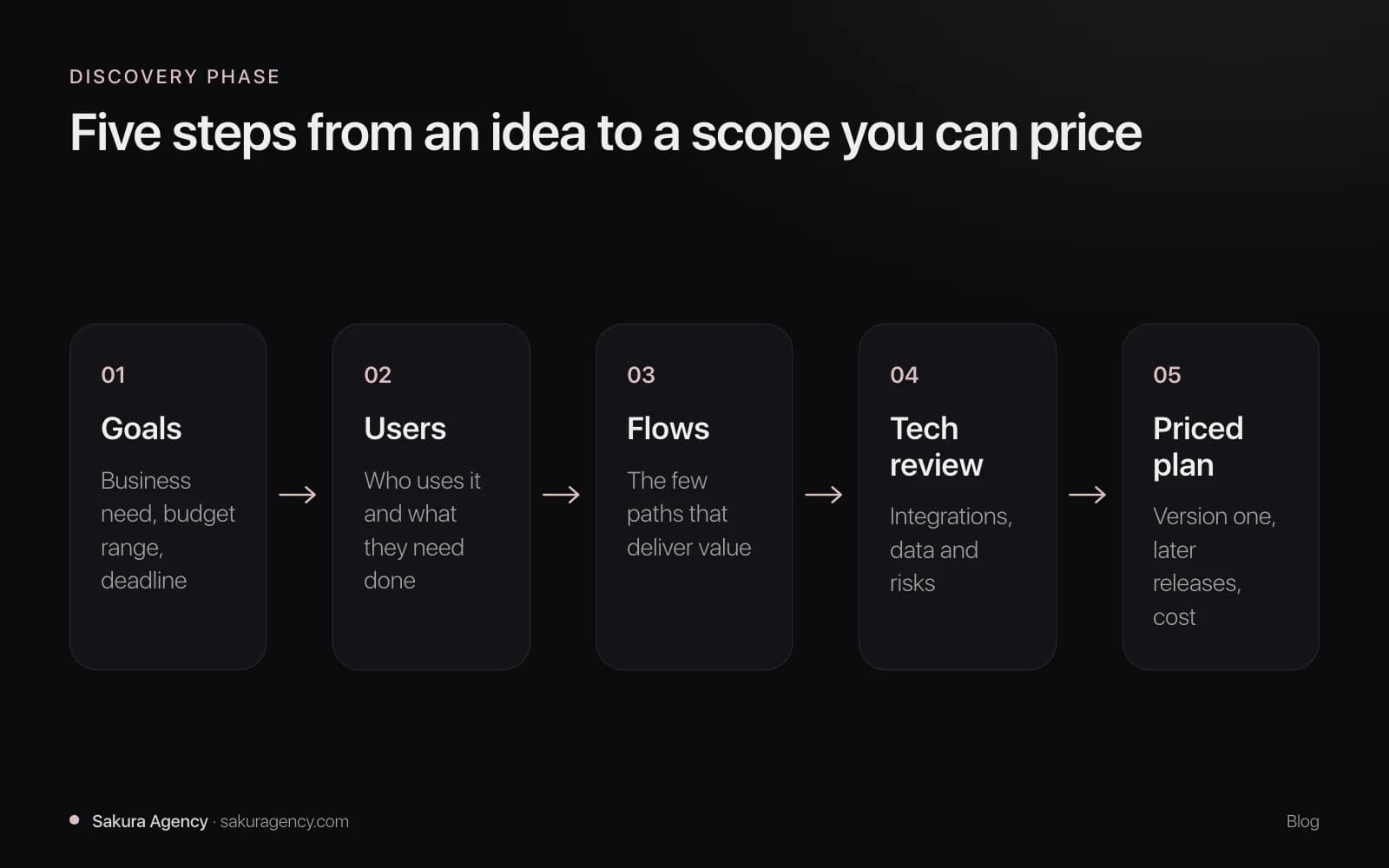
The exact activities depend on the product, but most discoveries follow the same order:
- Goals and constraints. What the business needs from the product, the budget range, the deadline and any rules it must follow.
- Users and their jobs. Who will use the product and what they are trying to get done, ideally from interviews rather than assumptions.
- Core flows. The handful of paths a user takes to get value, drawn as simple diagrams.
- Technical review. Integrations, data sources, existing systems and the riskiest technical questions.
- Scope and plan. What goes into version one, what moves to later releases, and the priced plan for the build.
GOV.UK's service manual puts the purpose of discovery simply: before you commit to building a service, you need to understand the problem it should solve. Commercial products are no different.
What should you get at the end of a discovery?
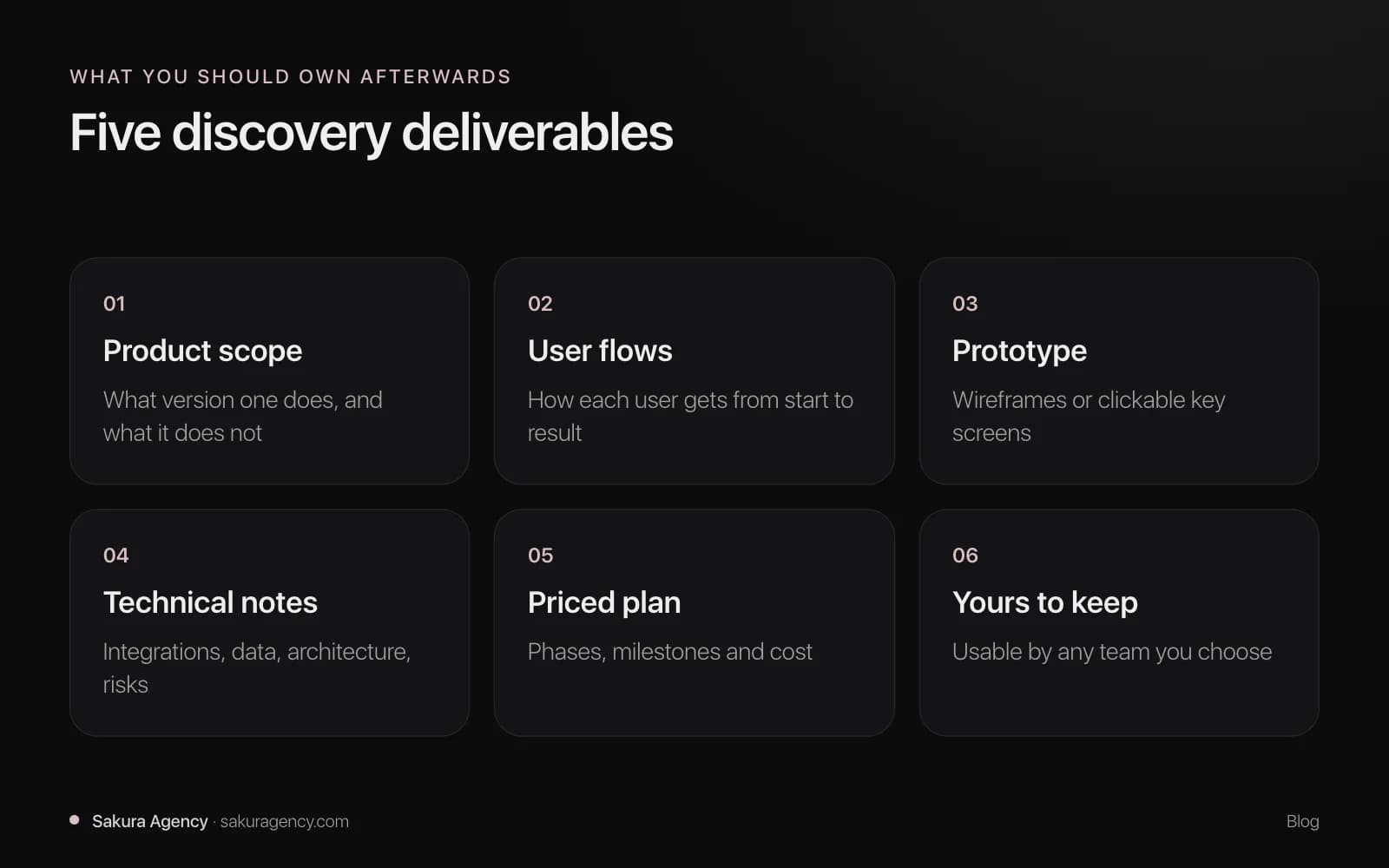
This is the most important question to ask before you pay for one. A discovery is valuable only if it leaves you with artefacts you can use, whoever builds the product.
| Deliverable | What it answers | Why it matters |
|---|---|---|
| Product scope | What version one does and does not include | The basis for any fixed price |
| User flows | How each user gets from start to result | Shows the real size of the product |
| Wireframes or a clickable prototype | What the key screens look like | Lets you test the idea with real users |
| Technical notes | Integrations, data, architecture and risks | Prevents surprises in development |
| Priced plan | Phases, milestones and cost | Lets you decide whether to build now |
Ask for examples from past discoveries before you sign. If an agency cannot show what its discovery documents look like, you will not know what you are buying.
How long does a discovery phase take?
For an MVP-sized product, a discovery usually takes a few weeks. A narrow product with one user role and no integrations needs less; a platform with several roles, payments and data from other systems needs more.
For comparison, the GOV.UK service manual says there is no set length for a discovery in public services, but around 4 to 8 weeks is typical. Commercial MVPs are usually smaller in scope, so their discoveries tend to be shorter.
Be careful with a discovery that has no end date. It should have a fixed duration, a fixed price and a list of deliverables, just like any other piece of work.
What does a discovery look like in practice?
AutoIntel is a B2B platform that gathers used-car listings from several German marketplaces into one workspace. The value of the product depended on data collected from other sites, which is exactly the kind of open question that makes a quote unreliable.
So the work started with the part the team would use every day: the workspace. We designed it and built an interactive prototype on a small set of sample listings, clearly labelled as such. The client walked through it with their team, settled which fields and filters mattered, and scoped the data pipeline around what the interface actually needed.
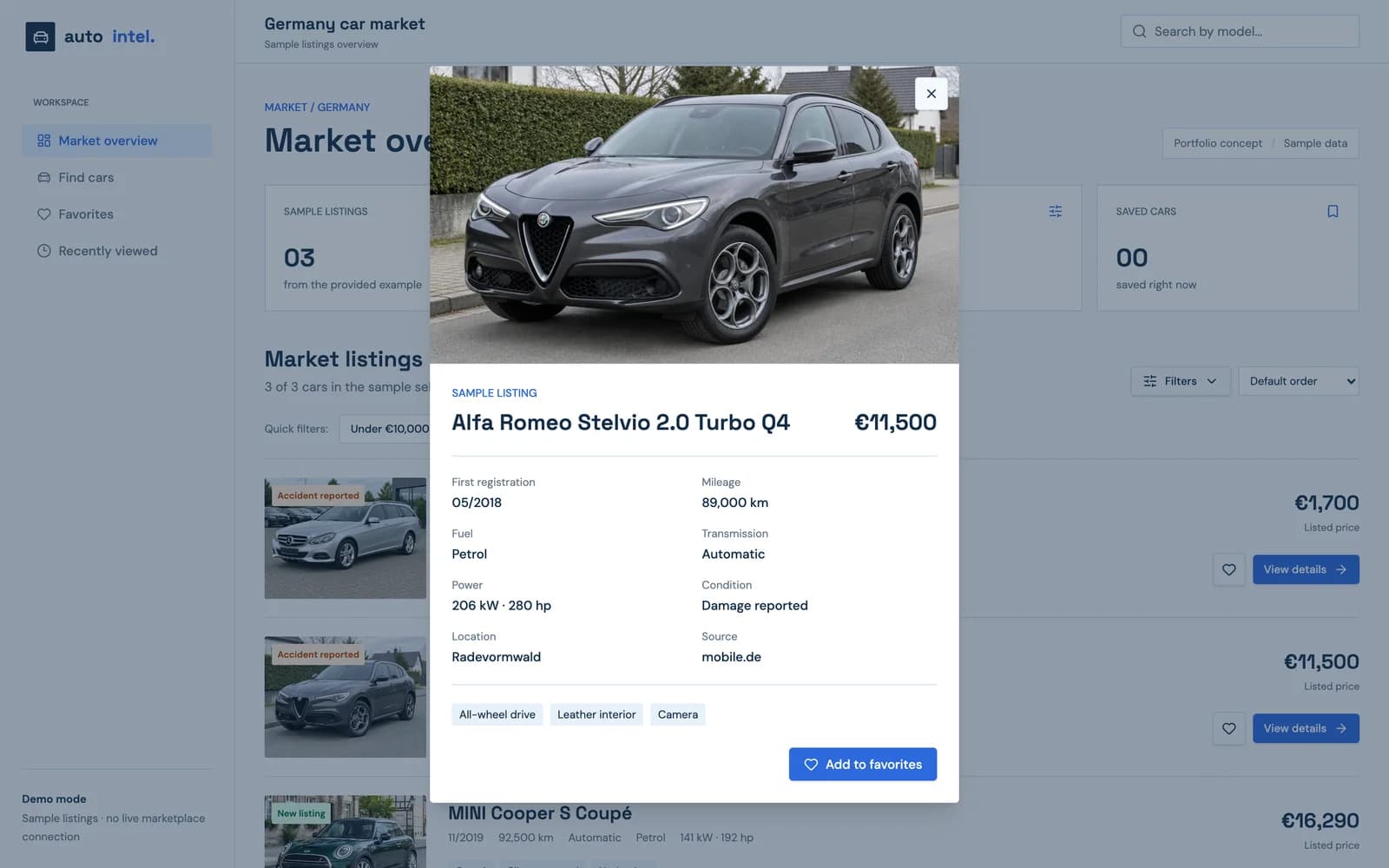
The prototype answered the questions that would otherwise have been answered in code. Which fields to normalise, how to show condition, which filters buyers actually use: each decision made the data work smaller and the estimate more reliable.
Should the discovery include a prototype?
Often, yes. Written requirements are easy to agree with and easy to misread. A clickable prototype shows everyone the same thing and lets real users react before anything is built.
Whether you need wireframes, a full prototype or a technical proof of concept depends on your riskiest question. Our guide to MVP vs. prototype vs. proof of concept explains which to build first.
A prototype made in real components is not thrown away later. We approach product design this way so that the flows approved in discovery become the first screens of the product.
Not sure how much discovery your idea needs? Send us a short brief and we will tell you honestly whether you need one at all.
When can you skip the discovery phase?
Discovery is not always necessary. Paying for one when the answers are already known is wasted money.
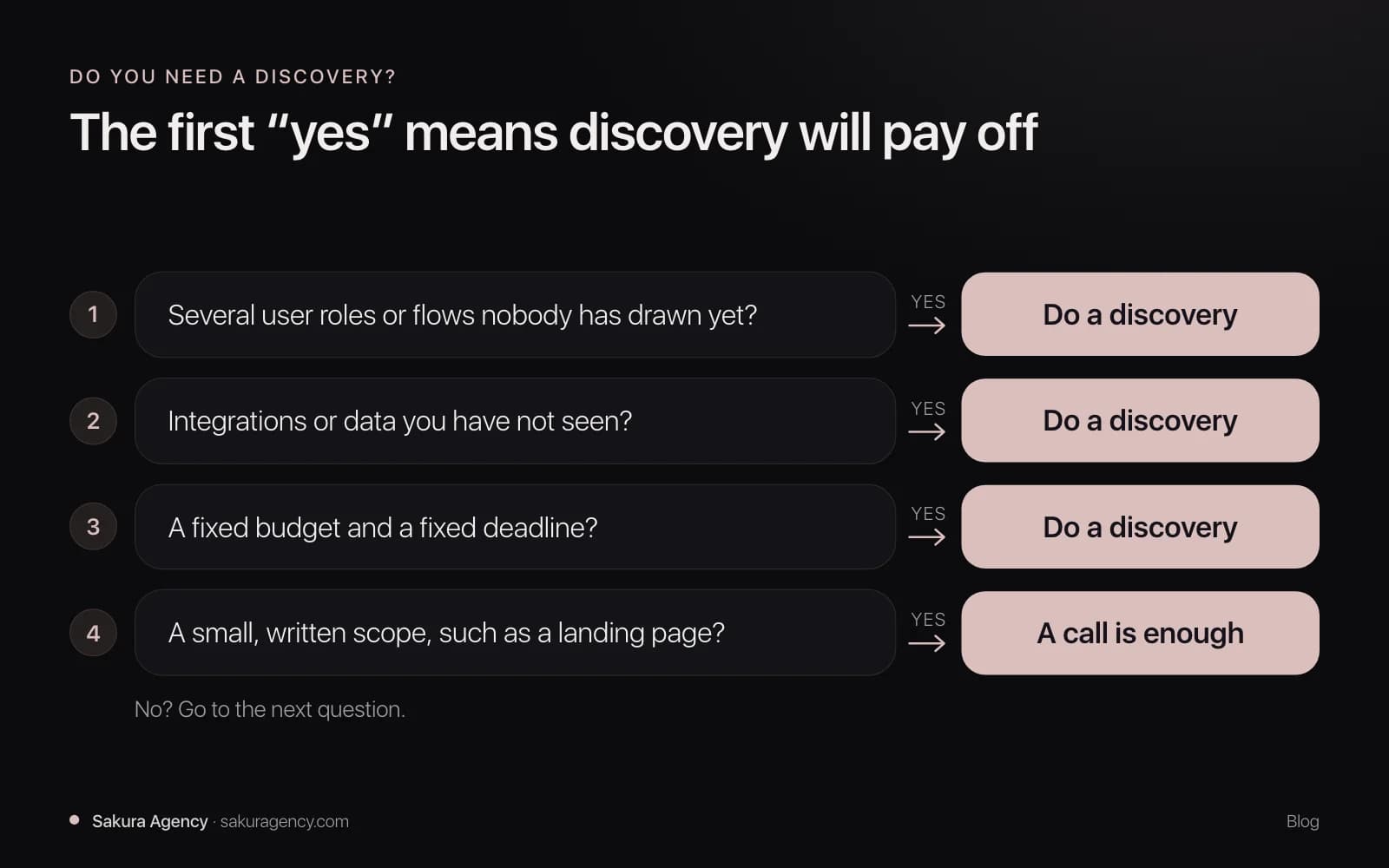
You can usually skip it, or keep it to a short call, when:
- the scope is small and fits on a page, such as a landing page or a simple marketing site;
- you already have detailed specifications, flows and designs from a previous team;
- the work is a clear extension of an existing product, like adding a known feature;
- the budget is so small that discovery would take a large share of it.
You should not skip it when there are several user roles, integrations with systems you do not control, data you have not seen yet, or a fixed deadline with a fixed budget. Those are the projects where a wrong assumption costs the most.
How much does a discovery cost?
It costs a small share of the build, and it should be priced as a separate, fixed piece of work. That way you can stop after discovery if the plan does not suit you, without being locked into the full project.
When comparing offers, check what is included for the money. Our guide on how to read a development proposal lists what a proposal should cover, and the same rules apply to a discovery: deliverables, timing, price and ownership.
One rule matters more than the rest: everything produced in discovery should belong to you. If you decide to build with another team, the scope, flows and prototype should go with you.
What are the warning signs of a bad discovery?
Not every discovery is worth its price. Watch for these signs before and during the work:
- No list of deliverables. If the proposal names meetings and workshops but no documents, you may pay for conversations only.
- No end date. Discovery should be a fixed piece of work, not an open-ended stage that quietly turns into development.
- The answer was decided in advance. If the scope at the end looks exactly like the first sales call, nothing was discovered.
- The results only work with that agency. Documents in a private tool, a prototype you cannot open, or estimates without a breakdown keep you locked in.
A good discovery changes something: a flow is cut, a risk is found early, a cheaper approach replaces an expensive one.
How do you get the most out of a discovery?
Discovery is a joint effort. The team does the research and the drafting, but only you know the business, the customers and the trade-offs you are willing to make.
- Bring the people who decide. If a co-founder or investor can veto the scope later, involve them now.
- Share what you already know. Customer interviews, analytics, competitor notes and past attempts all save time.
- Be clear about money and dates. A budget range and a deadline help the team cut scope sensibly.
- Make decisions quickly. Discovery stalls when questions wait a week for an answer.
- Test the prototype with real users. A few honest sessions are worth more than another round of internal opinions.
When your idea has open questions, tell us about your product. We will suggest the shortest discovery that gets you to a reliable scope and price.
FAQ
- What is the difference between discovery and design?
Discovery decides what to build and why; design decides how it looks and works in detail. Discovery usually produces flows and wireframes or a rough prototype, and full design continues from there.
- Is a discovery phase the same as a proof of concept?
No. A proof of concept tests whether something is technically possible. A discovery covers the whole product: users, flows, scope, risks and price, and may include a proof of concept for the riskiest part.
- Can I take the results of a discovery to another agency?
You should be able to. Agree in advance that the scope, flows, prototype and technical notes belong to you, so any team can price and build from them.
- How long does a discovery take for an MVP?
Usually a few weeks. A narrow product with one user role needs less time; several roles, payments and integrations need more.
- What if the discovery shows the idea is too expensive?
That is a useful result. You can cut the first version, change the approach or stop, having spent a small share of what the full build would cost.
About the author
Ivan Savsuik
Co-founder of Sakura Agency. Leads product and design.